



It is estimated that around 50 million people worldwide play the guitar. This makes it the second most popular instrument of all, after the piano or keyboard.
The acoustic guitar is one of the instruments with which children of all ages enter the world of music. Both younger and older beginners rely on instruments that are easy to play and of solid quality. In addition, the dimensions of the guitar must match the size of the music-loving kids.
To help with this, we have developed a practical online tool that can make choosing the right guitar much easier – more on that below. But first, here are our general tips on what to look out for when buying a guitar for children.
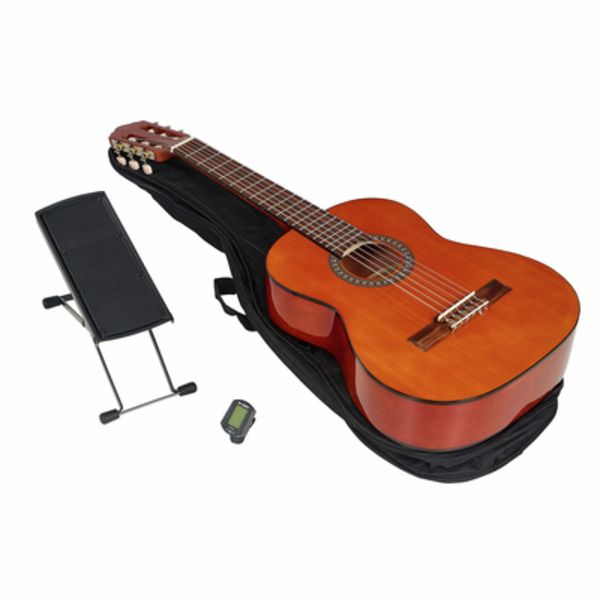
Thomann
C-402 NT Set
🎸 Guitars for Children: Student Guitars in a Wide Range of Sizes
The 4/4 size classical guitar – the general standard – is designed for a height of 1.80 m, although it is of course possible to play this size even if you are below this general guideline. Even so, it quickly becomes apparent that smaller adults can also reach their limits with such instruments.
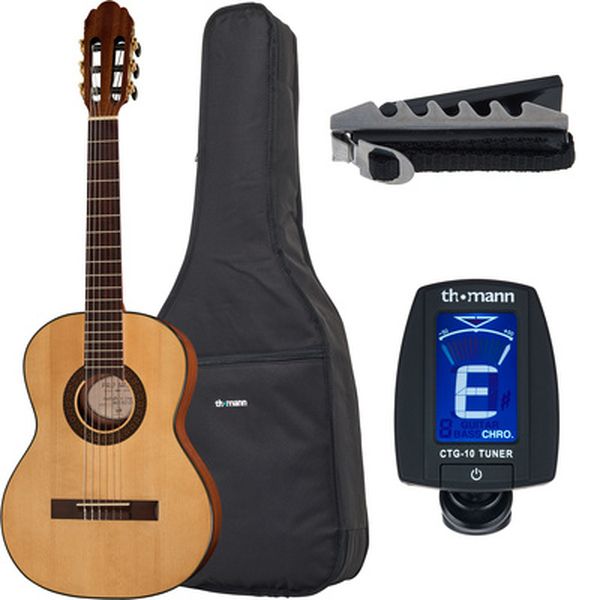
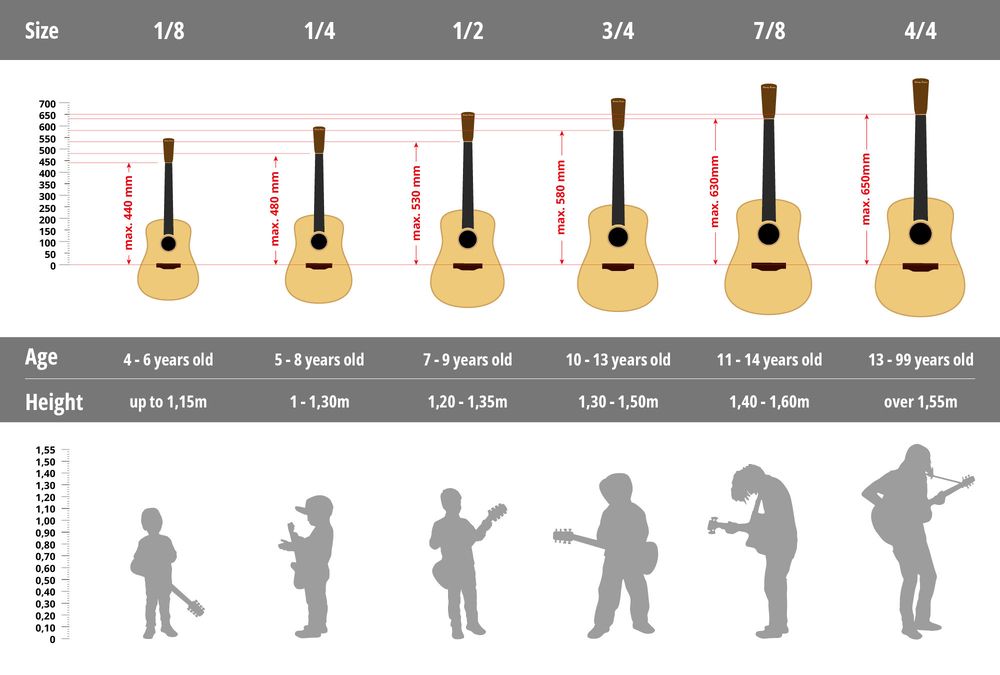
Fortunately, acoustic guitars are built in a variety of different sizes suitable for children and teenagers. The most common smaller student guitar sizes are the 7/8, 3/4, 1/2 and 1/4 sizes. It becomes truly adorable with the 1/8 size. Start early! Click here for all classical guitars at thomann.de.
Gewa
Pro Arte GC75A Bundle
Note: Tables and our tips provide parents with general guidance when it comes to guitars for children. Ultimately, it is the child who decides which instrument feels comfortable. As every child is different and has a unique physique, the young musician should always try the instrument out.
Guitars for Children: Fully-Fledged Instruments Free from Any Toy Factor
Important to understand: Even the smallest guitars are not toys, but fully-fledged instruments that are on a par with adult instruments in terms of quality. And with a 1/2 size, the instrument is not simply shrunk to exactly half its overall dimensions. With guitars for children, the main focus is on the scale length – the length of the freely vibrating strings – which in turn affects the number of frets and the spacing between them. The smaller body size ensures that the instrument is not quite as loud and slightly less bass-heavy.
A Brief Excursus: Classical vs. Steel-String Acoustic Guitars
For starting out, acoustic guitars with a classic design – concert guitars / classical guitars – are best suited. The necks of the guitars are relatively wide (compared to western guitars ). This makes it easier for beginners, in particular, to grasp. In addition, the nylon strings used are gentle on the fingers. Nylon strings are not only much softer than the steel strings used on western guitars but they also have a lower tension, so that pressing down is easier. You can find more information about the differences here.
General Recommendations for Children’s Guitars Can Only Ever Be Rough Guidelines
But how are parents – and the children themselves – supposed to determine the right guitar size? Of course, we can approach the subject with a solid foundation of background knowledge. There are extensive papers and specific recommendations, for example from the European Guitar Teachers Association (EGTA), based on decades of experience and in some cases complex calculations.
Nevertheless, these general recommendation tables should be read with caution, as they cannot reflect the individuality of each child. A child may be small but have relatively long arms and fingers – or vice versa.
Finding the Right Guitar for Children: The Proven Elbow Test by Ekhard Lind
The so-called elbow test by Ekhard Lind, the former concert guitarist who taught for around a quarter of a century at universities in Salzburg and Stuttgart, has also proven its worth. Finding the right guitar for children is very simple with this method: In Lind’s elbow method, the guitar is placed upright with the headstock facing upwards. The guitar student then places their elbow on the body and holds the arm parallel to the neck. Ideally, the lowest knuckle of the wrist should be positioned between the first and second frets.
Practical Guidance: Our Online Tool
However, if you simply want to buy a bread roll, you wouldn’t first train as a baker. To give you an equally straightforward and reliable way to orientate and inform yourself in advance when choosing an acoustic guitar, we have integrated a practical tool with recommended size and age information for acoustic guitars into our shop, helping you find the right guitar for your child. Just click on the corresponding button and you will immediately see suggestions with suitable guitars in the respective size.
Click here to access the Classical Guitars! 👇
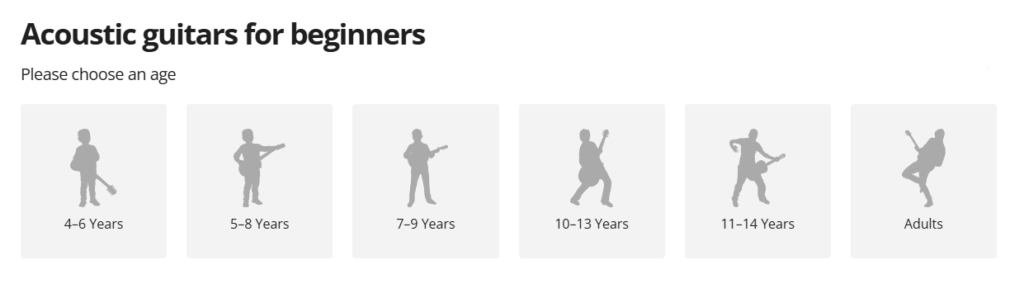
Examples of Which Guitar Sizes Make Sense for Which Age and Height
Of course, categorising purely by a child’s age has its pitfalls. After all, children grow at different rates, and what really matters is their height and, in particular, the length of their arms. Age is therefore only a very general point of reference. Or, to put it another way:
If your 15-year-old child towers over you by two head lengths, that doesn’t automatically make them older than you. But let’s not digress – back to the topic at hand: finding the right guitar for your child. Here are a few specific suggestions as to which guitars make sense for which age and height …
4 to 6 years
For kids aged 4 to 6 with a height of around 100 cm, 1/8-size acoustic guitars are recommended. The Startone CG 851 1/8 is perfect for the youngest guitarists among us. This classical guitar is primarily aimed at children between 4 and 7 years old. With a scale length of just 44.5 cm and a nut width of 39 mm, it is easy to play with smaller fingers – perfectly suited to the needs of young beginners!
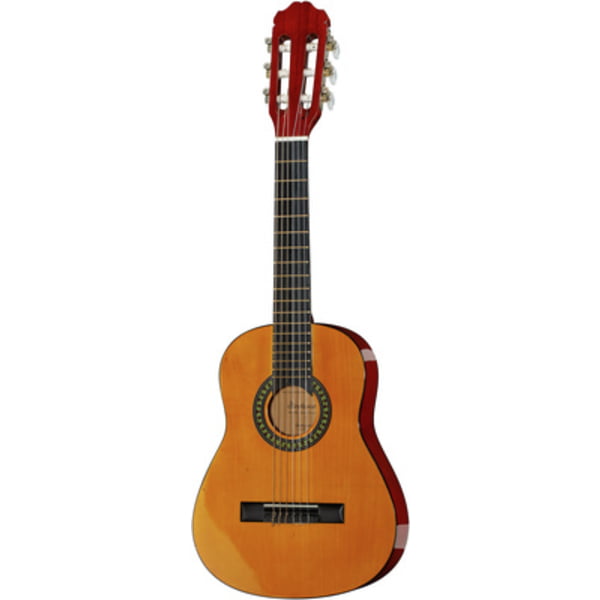
Startone
CG 851 1/8
5 to 8 years
For 5 to 8-year-olds, a typical height ranges from around 110 to 130 cm. Children in this age group, with corresponding arm and finger length, will generally find a 1/4-size guitar to be a good fit. A strong and equally popular example is the classical guitar Gewa Student Natural 1/4, a model from the Natural series, which is also available in various wood options in addition to this spruce-top version.
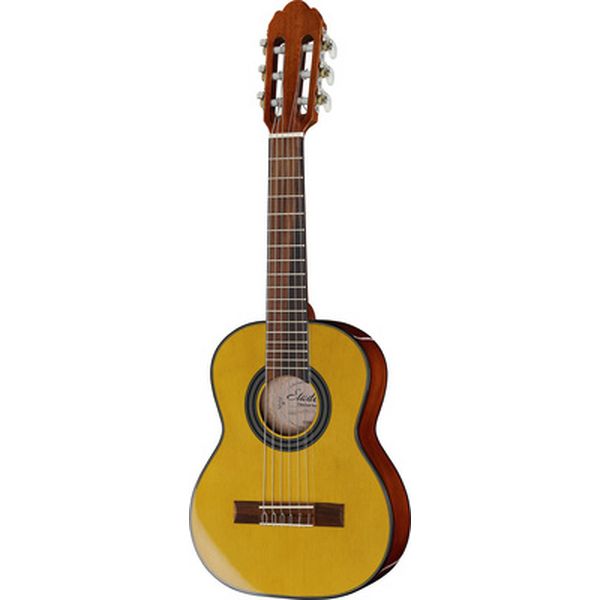
Gewa
Student Natural 1/4
7 to 9 years
As the years go by, children grow – and so do the suitable student guitars. At 7 to 9 years old, with an average height of 120 to 140 cm, children can already move up to 1/2-size classical guitars. One example that fits these dimensions is the La Mancha Romero Granito 32-1/2 N, a high-quality instrument with a scale length of 530 mm and a nut width of 43 mm.
The open-pore, matte natural finish is particularly tasteful, making this guitar a real source of pride for young players. Spruce top, mahogany back and sides – just like its full-size counterparts.
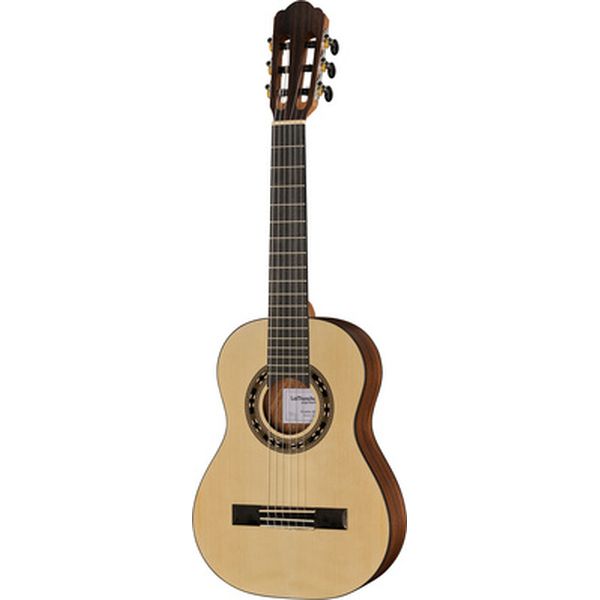
La Mancha
Romero Granito 32-1/2 N
10 to 13 years
The next step up is the 3/4-size guitar, aimed at students aged 10 to 13, typically with a height of around 130 to 150 cm. As with all other models, the focus here is on solid build quality, good tone and comfortable playability. One such example is the Thomann Classic Guitar 3/4 Black, which stands out from the crowd with its high-gloss black finish. This popular instrument features a laminated spruce top, maple back, sides and fingerboard, along with nickel-plated machine heads. In many ways, it represents the classic route into playing guitar.
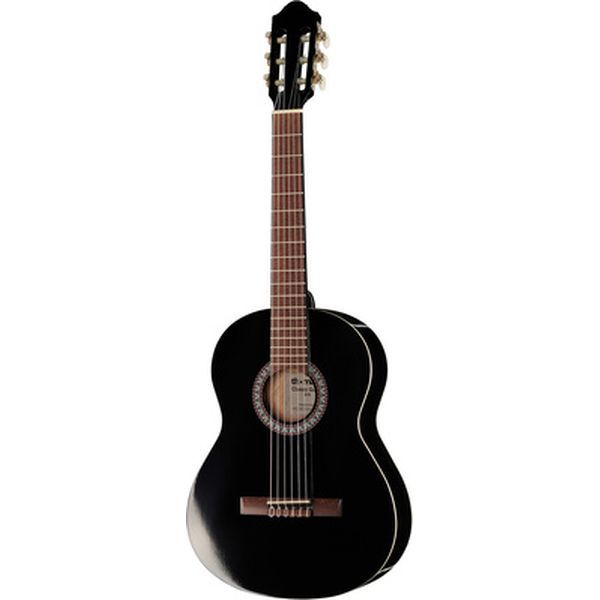
Thomann
Classic Guitar 3/4 Black
11 to 14 years
And they continue to grow: between the ages of 11 and 14, children – now almost teenagers – typically reach a height of around 140 to 160 cm. The corresponding student guitars are reflected in the so-called 7/8 size.
Once again, this makes it clear that it’s not primarily about age, but rather about arm and finger length. GEWA offers a visually particularly appealing instrument in this category. The Gewa Pro Natura Silver 7/8 Maple comes in a natural finish with a silky matt lacquer. A definite advantage: this classical guitar features a solid spruce top.
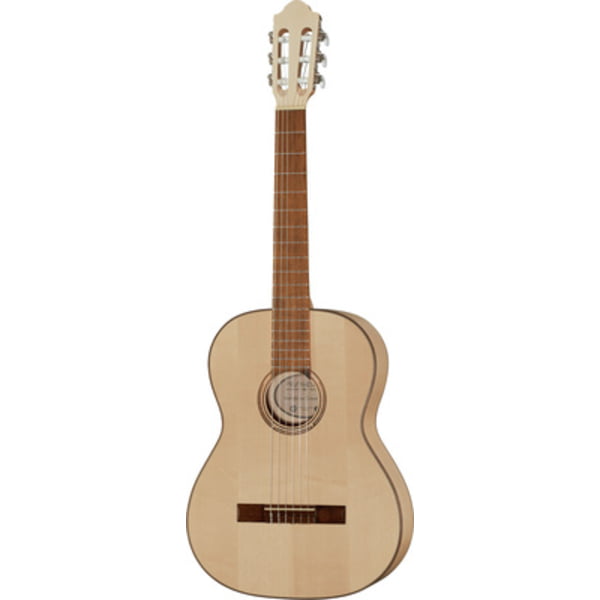
Gewa
Pro Natura Silver 7/8 Maple
For Adults / Fully Grown Teenagers
Ultimately, the journey leads to “adult guitars” – 4/4-size classical guitars. Scholars have often pondered why we refer to a 4/4 guitar instead of simply calling it a guitar. After all, we don’t say “4/4 car”. It’s somewhat paradoxical that instrument size is standardised in this way.
Many teenagers eventually tower over their parents. But the direction is clear – at some point, there is no larger standard size. A popular entry-level instrument for both growing players and parents alike is the Yamaha C40 III, built with a spruce top and a rosewood fingerboard. And to illustrate the difference in dimensions once again: the guitar has a scale length – the length of the freely vibrating strings – of 650 mm and, thanks to its larger resonance body, delivers the full development of bass frequencies.
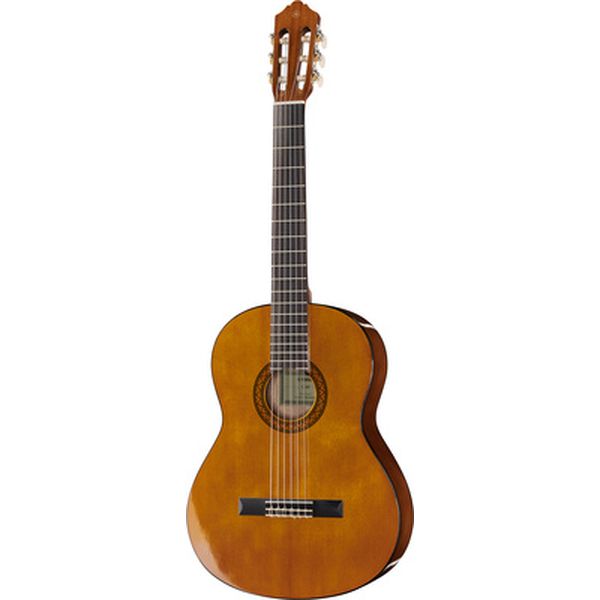
Yamaha
C40 III
Guitars for Children: Get Personal or Telephone Advice When Buying a Guitar
In most cases, you won’t have measured your children down to the exact centimetre – and that’s not necessary. Even then, it would hardly lead to a definitive answer. Ultimately, when buying a guitar for children, the most important thing is that they feel comfortable with and on the instrument. If there’s no clear result, ideally let them try out different sizes.
No general list can replace personalised advice: our tips and recommendations for children’s guitars already provide important guidance to help you make a meaningful purchasing decision and find your child’s dream instrument.

Once your plans become more concrete, we can only recommend seeking advice from the experts in our Thomann guitar department or contacting our hotline directly. Our specialists draw on daily hands-on experience and are all musicians themselves. They will answer your questions clearly and on equal musical footing. Whether in person at our shop in Treppendorf or by phone – our team will be happy to advise you with no obligation.
📞 09546 / 9223 20
🗨 Chat on thomann.de
🎸 Browse guitars at thomann.de
📚 Online guide with more information on classical guitars

Guitars for Children: Feedback
Have you already bought a guitar for your child, or did you receive one yourself as a child? Feel free to share your experiences with us in the comments. 👇












Comments 9