


P
Perfect light 6 string bass
I wanted to get a light, yet powerful and versatile 6 string bass.
Having 6 string, 4 string, musicman style, PJ style basses I all like, I really wanted a headless one for simpler transport, less weight on the shoulder. And I don't understand why people go 5, if you can get 6 ;-).
Living far from any high end guitar shops where you can test or buy decent basses, I was thinking of buying this bass online. The question was: black sandblasted ash or red mahogany. Most videos/online places only talk about the sandblasted one, hard to make a decision for to me such an important criteria.
Then by chance I was able to play a sandblasted 5 string version by myself in a shop. The sound versatility was fantastic, the weight/balance as well. But the sandblasted wood was very strange to me. Now this is personal, but I write this review as I believe lot of players do ask themselves what is that sandblasted thing about. Hopefully this helps.
The sandblasted wood is very "structured", and gives very special/intriguing look. But as its so structured it seems they have to covered it with very strong/tough painting. If you take the bass the wood does not feel like wood, more like very solid plastic. I hope you ge the point, it is definitely wood, but the feel you get is not really the typical wood touch. I did not like that at all. The look is very amazing, but to me feeling of the bass is also important.
So I ordered the mahogany M6 6 string. I was super nervous on delivery. bass quality etc. until I got it.
I got it, and well, I don't want to sound naive or like a Sire fan boy..
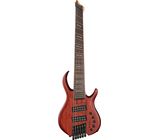
First thought was, it is SOOOO beautiful. the Mahogany is polished, rarely seen a bass finish like that. The neck is superbe. It is huge/large but so smooth. Playability is top. Immediatly plugged in, to play it. As the battery are separately in the box you start playing passive mode, and it just sounds...
My second thought was, what the hell to do now with all my other basses now, I can sell them as they are useless now (except maybe the fretless one). No kidding :-).
Now let's get to the instrument itself.
- Body Balance 5 of 5, there is a tiny tiny little trend to slide of the leg to the right as all the weight is at the lower end of the bass.
- Passive mode sounds super, like on any Sire bass I played so far. The B string sounds good, but you don't get the 37" Dingwall sound, which is normal as the scale is "35.
- Amp and pickup switches: very versatile, a bit over complex, and you can end up with, to me, useless sounds. but you also have tons of very good sounds. This just needs adaptation and playing around, getting used to. It is good to have all options.
- Neck, as said just perfect to play. Round and smooth, the strings are set super low and very well playable. I actaully increased the string height as I am looking for fat sound.
- Fan frets / fingerboard: I think the important question for anyone is, do I get around with fan frets or not. To be honest if there would be the same bass in normal frets I would have preferred, as I would stay with the same system as on all me other basses, including my fretless. But I did not like the M10 look and LeFay, Dingwall 6 string headless are too expensive. I therefore spent a bit of time on this aspect in the review. The white dots on the side of the neck are almost invisible. When playing they won't help you really to see where you are. The inlays are all looking by itself identical so again they are of not much help. In addition due to the frets going accros, looking from the top on the fingerboard is at the beginning confusing to see where your fingers are. But I realized, when I play not looking at the finger board as I read the partition (big band music), my finger just hit the right note as on a normal fret system. My take is, Sire fan fret is very natural to the finger movement. Now after few weeks I feel super comfortable playing it. But whenever you have to look up in a hurry where you are on the fingerboard, it is less evident than on a straight system, keep that in mind. I played Ibanez fanfret and Dingwalls. Dingwalls I found is also very good/natural, while Ibanez is very different, less natural.
Some people mention problem with the pointiness of the string holder on the C string. Yes it is super picky. I do not come to touch it when playing, for me a no issue. If it becomes one I un-mount it, file it round a bit and done... Sire could do that indeed already by factory default in the future.
The tuners itself is ok to tune. Some people say its super smooth without force, while the "old tuners" where almost impossible to tune. On my one you still need a bit of force to tune, not a problem for me, but a child would have issues tuning this, compared to the classic tuners on a head stock bass...
Wanted to do a quick review, finally longer than what was planned.
By the way, it fits in a hanging stand from Hercules. That is a nice plus.
Having 6 string, 4 string, musicman style, PJ style basses I all like, I really wanted a headless one for simpler transport, less weight on the shoulder. And I don't understand why people go 5, if you can get 6 ;-).
Living far from any high end guitar shops where you can test or buy decent basses, I was thinking of buying this bass online. The question was: black sandblasted ash or red mahogany. Most videos/online places only talk about the sandblasted one, hard to make a decision for to me such an important criteria.
Then by chance I was able to play a sandblasted 5 string version by myself in a shop. The sound versatility was fantastic, the weight/balance as well. But the sandblasted wood was very strange to me. Now this is personal, but I write this review as I believe lot of players do ask themselves what is that sandblasted thing about. Hopefully this helps.
The sandblasted wood is very "structured", and gives very special/intriguing look. But as its so structured it seems they have to covered it with very strong/tough painting. If you take the bass the wood does not feel like wood, more like very solid plastic. I hope you ge the point, it is definitely wood, but the feel you get is not really the typical wood touch. I did not like that at all. The look is very amazing, but to me feeling of the bass is also important.
So I ordered the mahogany M6 6 string. I was super nervous on delivery. bass quality etc. until I got it.
I got it, and well, I don't want to sound naive or like a Sire fan boy..
First thought was, it is SOOOO beautiful. the Mahogany is polished, rarely seen a bass finish like that. The neck is superbe. It is huge/large but so smooth. Playability is top. Immediatly plugged in, to play it. As the battery are separately in the box you start playing passive mode, and it just sounds...
My second thought was, what the hell to do now with all my other basses now, I can sell them as they are useless now (except maybe the fretless one). No kidding :-).
Now let's get to the instrument itself.
- Body Balance 5 of 5, there is a tiny tiny little trend to slide of the leg to the right as all the weight is at the lower end of the bass.
- Passive mode sounds super, like on any Sire bass I played so far. The B string sounds good, but you don't get the 37" Dingwall sound, which is normal as the scale is "35.
- Amp and pickup switches: very versatile, a bit over complex, and you can end up with, to me, useless sounds. but you also have tons of very good sounds. This just needs adaptation and playing around, getting used to. It is good to have all options.
- Neck, as said just perfect to play. Round and smooth, the strings are set super low and very well playable. I actaully increased the string height as I am looking for fat sound.
- Fan frets / fingerboard: I think the important question for anyone is, do I get around with fan frets or not. To be honest if there would be the same bass in normal frets I would have preferred, as I would stay with the same system as on all me other basses, including my fretless. But I did not like the M10 look and LeFay, Dingwall 6 string headless are too expensive. I therefore spent a bit of time on this aspect in the review. The white dots on the side of the neck are almost invisible. When playing they won't help you really to see where you are. The inlays are all looking by itself identical so again they are of not much help. In addition due to the frets going accros, looking from the top on the fingerboard is at the beginning confusing to see where your fingers are. But I realized, when I play not looking at the finger board as I read the partition (big band music), my finger just hit the right note as on a normal fret system. My take is, Sire fan fret is very natural to the finger movement. Now after few weeks I feel super comfortable playing it. But whenever you have to look up in a hurry where you are on the fingerboard, it is less evident than on a straight system, keep that in mind. I played Ibanez fanfret and Dingwalls. Dingwalls I found is also very good/natural, while Ibanez is very different, less natural.
Some people mention problem with the pointiness of the string holder on the C string. Yes it is super picky. I do not come to touch it when playing, for me a no issue. If it becomes one I un-mount it, file it round a bit and done... Sire could do that indeed already by factory default in the future.
The tuners itself is ok to tune. Some people say its super smooth without force, while the "old tuners" where almost impossible to tune. On my one you still need a bit of force to tune, not a problem for me, but a child would have issues tuning this, compared to the classic tuners on a head stock bass...
Wanted to do a quick review, finally longer than what was planned.
By the way, it fits in a hanging stand from Hercules. That is a nice plus.
0
0
Signaler l'évaluation