


Shure KSM 9 HS B-Stock

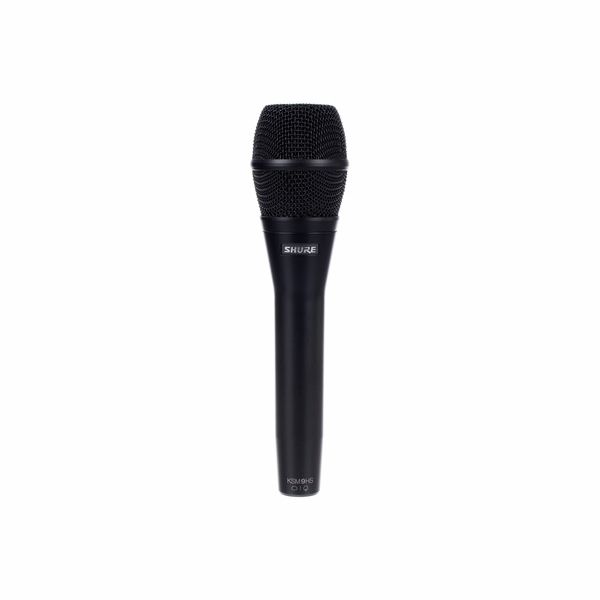
High-End Condenser Vocal Microphone for Live Applications
- Dual diaphragm
- Switchable polar pattern: Hypercardioid/subcardioid
- Frequency response: 50 - 20.000 Hz
- Sensitivity: -51 dBV/Pa / 2.81 mV/Pa
- Max. SPL (sound pressure level): 152 dB
- Die-cast metal housing
- Minimal handling noise
- Great protection against feedback
- Triple pop filter
- Weight: 300 g
- Colour: Black
- Includes case
-
Available since April 2013
-
Item number 315413
-
Sales Unit 1 piece(s)
Great sound at both ends of the spectrum
The Shure KSM9HS is a premium dual-diaphragm condenser vocal microphone that shares the same capsule architecture, Class A discrete transformerless preamplifier, and build quality as the KSM9, but replaces the cardioid/supercardioid polar patterns with hypercardioid and subcardioid. Together, these two patterns cover opposite ends of the directional spectrum: maximum isolation and tight directional control for hypercardioid, and a broad, natural pickup for subcardioid. The KSM9HS is thus suited both to applications where either maximum isolation or unusually broad pickup is required. The frequency response extends from 50Hz to 20kHz, with a naturally rolled-off low end and a gentle upper-midrange lift. Self-noise is rated at 20.7dB SPL-A in hypercardioid mode with a maximum SPL of 150.9dB, which translates into plenty of headroom for powerful vocals, without the mic itself being audible when things get quieter.

)
Two patterns, two distinct tools
The Shure KSM9HS is aimed at engineers who regularly work across situations where the KSM9's cardioid and supercardioid patterns are not enough. The hypercardioid pattern provides maximum isolation and gain before feedback on loud stages, where adjacent instruments, floor wedges, or nearby performers place a premium on tight off-axis rejection. At the opposite extreme, the subcardioid pattern offers a wider, more forgiving pickup for backing vocal groups, acoustic performers who move around the microphone, and ensembles where a little extra freedom of movement is preferable to maximum isolation. Engineers and performers whose work stays within the cardioid-to-supercardioid range will find the KSM9 offers the same platform with patterns better suited to general live vocal use.
)
)
The dual-diaphragm advantage
The Shure KSM9HS's dual 3/4" gold-layered low-mass Mylar diaphragms work in combination to control the proximity effect, producing a more consistent vocal sound across a wider working range than a single-diaphragm condenser. The Class A discrete transformerless preamplifier preserves fast transients while keeping harmonic and intermodulation distortion to a minimum, and gold-plated internal and external connectors maintain signal integrity throughout the audio path. A permanent subsonic filter attenuates frequencies below 17Hz, eliminating mechanical rumble before it reaches the preamplifier. The three-stage grille effectively controls plosives, moisture, and breath noise, while the advanced suspension shock mount reduces handling noise during demanding live use.
)
About Shure
The American company Shure began developing microphones during the early 1930s and is one of the pioneers of the audio engineering sector. Models such as the 55 Unidyne – known to many as the "Elvis microphone" – and the SM57 and SM58 which appeared in the mid-1960s are still ubiquitous in live sound production today. They enjoy cult status among musicians and technicians alike. In the 1990s, Shure introduced the first wireless microphones and in-ear monitoring systems and became a market leader in this field. In addition to microphones, Shure offers a wide range of earphones and headphones for studio and live use, as well as various accessories.
So flexible – and yet so reliable
In practice, the Shure KSM9HS adapts quickly to very different live environments, so performers and engineers aren't forced to change microphones if the setting changes. Subcardioid mode provides the broader, more natural pickup that suits backing vocal groups, acoustic ensembles, or expressive performers who move freely around the microphone. Switching to hypercardioid tightens the pickup for louder stages, where maximum rejection helps keep neighbouring instruments and monitors under control. The most meaningful advantage in a professional audio context is the way that, across both patterns, gain structure and tonal balance remain consistent at the console, allowing engineers to adapt the mic's directivity to the gig's demands without fundamentally changing the sound of the vocal. Whether the priority is maximum isolation or broader, more natural coverage, the transition remains predictable at the mixing desk – a real relief when the same microphone needs to perform reliably across very different environments in the same evening.