


Pulsar Audio 8200
4.8 out of 5 stars from 4 customer ratings
()

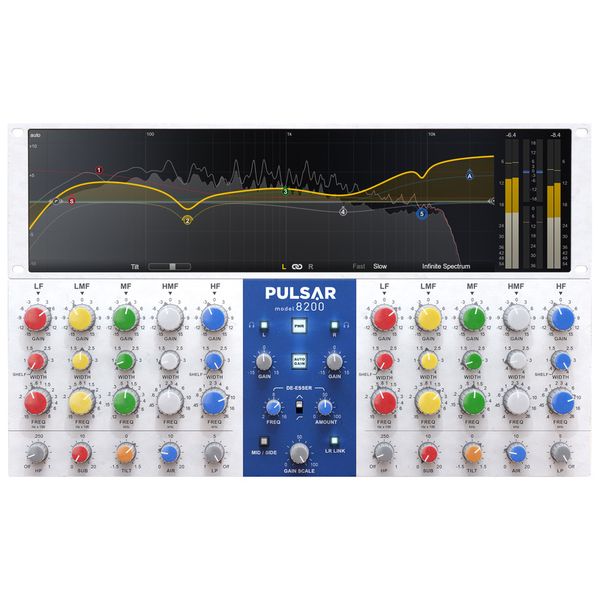
Equaliser Plug-In (download)
- Careful emulation of a legendary, discrete Class A equaliser from the 1980s for a variety of mixing and mastering tasks
- Parallel filter circuitry combined with unique filter design allows intuitive sound shaping with smooth filter progression for natural results
- Operation via editable frequency curve with a built-in spectrum analyser or classic control set
- Complementary functions such as integrated de-esser, tilt filter, sub- and air-band etc.
- Stereo or M/S processing selectable
- Auto-gain function with C-weighted algorithm keeps the output level consistent
- Extensive metering options
- Flexible and scalable user interface
System Requirements
- Shipping Format: E-Mail
- License validity: perpetual
- Copy Protection: iLok 2 / iLok 3 (401447) / iLok Cloud / Machine License
- Simultaneous Activations: 3
- Windows: from 7 (64-Bit)
- Mac OS (64 Bit): from 10.9
- CPU min.: Intel Core i3
- CPU compatibility: Apple Intel, Apple Silicon, Windows AMD, Windows Intel
- RAM min.: 4 GB
- HD Storage min.: 1 GB
- Display: 1024 x 768
- add. System requirements: Internet Connection for Installation and Activation, iLok License Manager
Supported Formats
- AAX native 64-Bit
- AU 64-Bit
- VST2 64-Bit
- VST3 64-Bit
-
Available since May 2023
-
Item number 566508
-
Sales Unit 1 piece(s)
-
Los artikel / bundelartikel Los artikel
-
Delay No
-
Dynamics No
-
Effect Filter No
-
Encoder/Decoder No
-
Equalizer Yes
-
Guitar amps/-effects No
-
Channel Strip No
-
Metering / Analysis / Correction No
-
MIDI-FX No
-
Modulation Effects No
-
Multieffect / Plugin-Host No
-
Overdrive/Distortion No
-
Preamp / Saturation No
-
Psychoacoustic tool / Enhancer / Exciter No
-
Restauration No
-
Reverb No
-
Special FX No
-
Summer / Mixing Consoles No
-
Tape Simulation No
-
Pitch Shifter / Harmonizer / Timestretching No
-
Transient Processing No
-
Vocoder / Vocal effect No
-
Mastering Tools Yes
-
Hardware Controller No
-
Download Yes
