

Groove Synthesis 3rd Wave Desktop Module

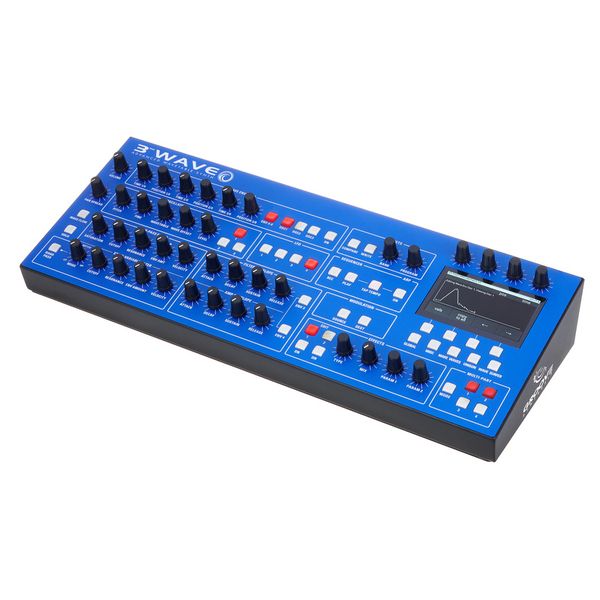
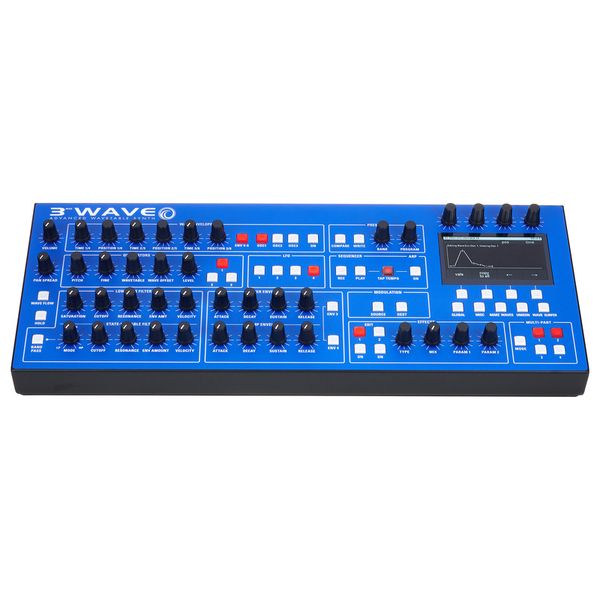
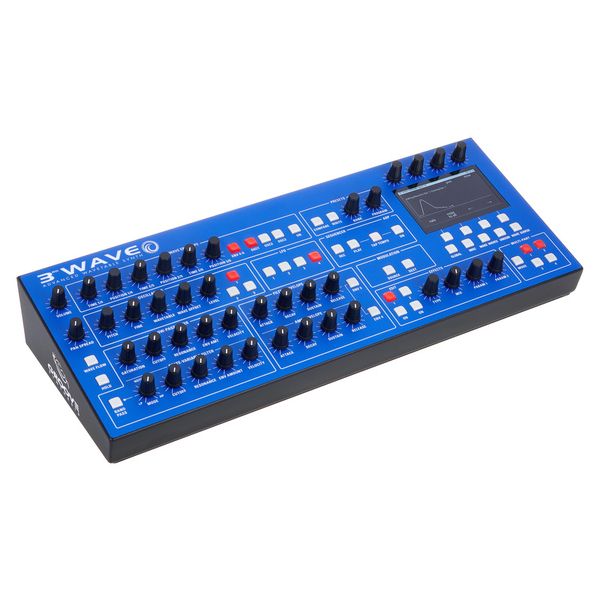
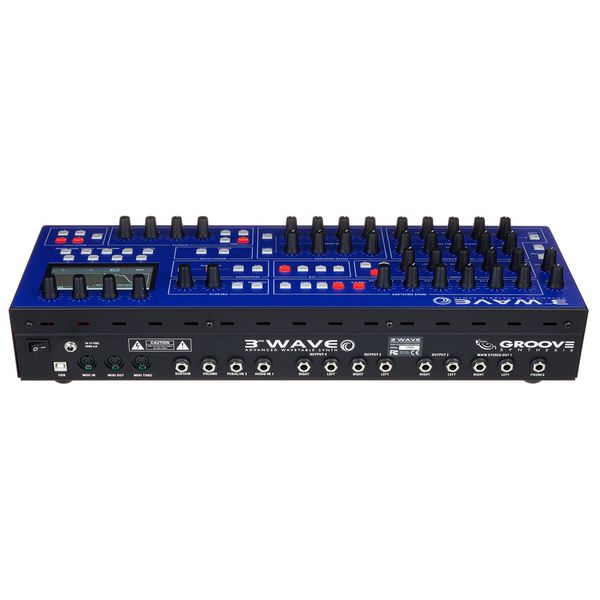
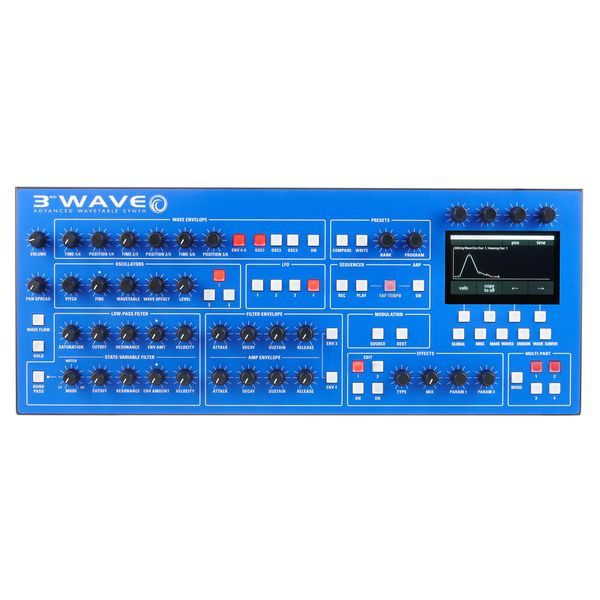
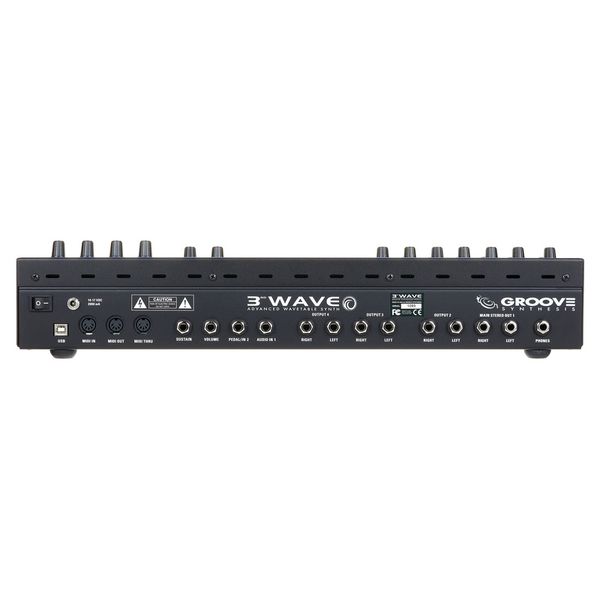
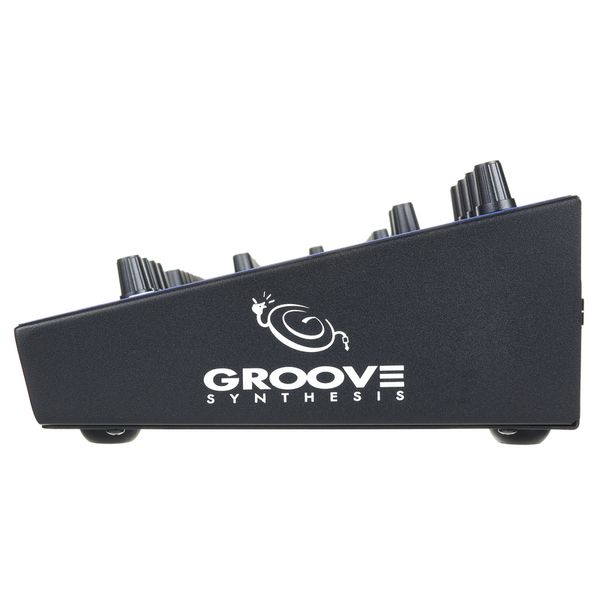
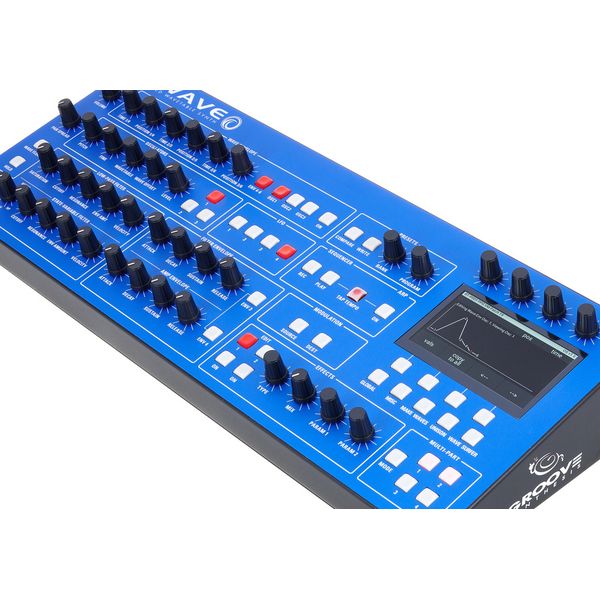
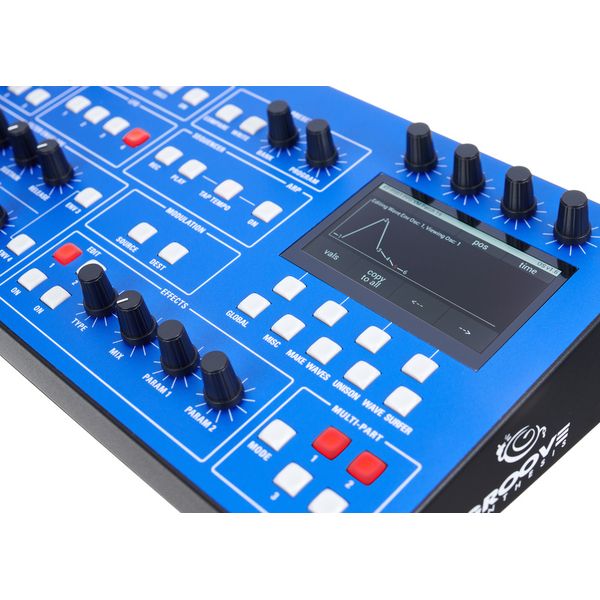
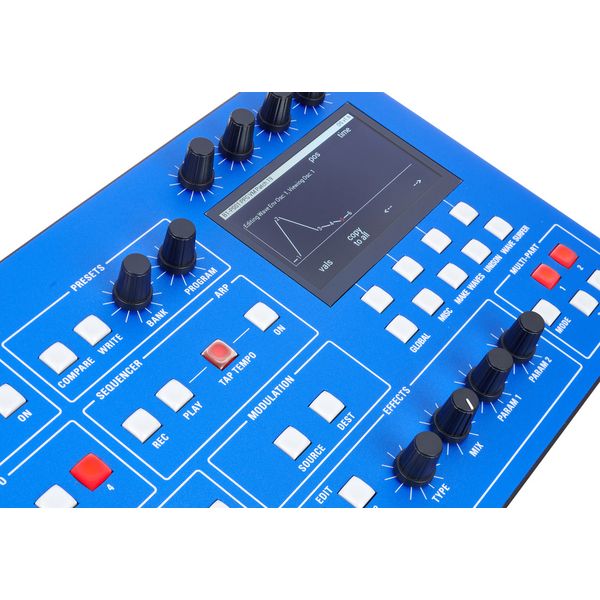
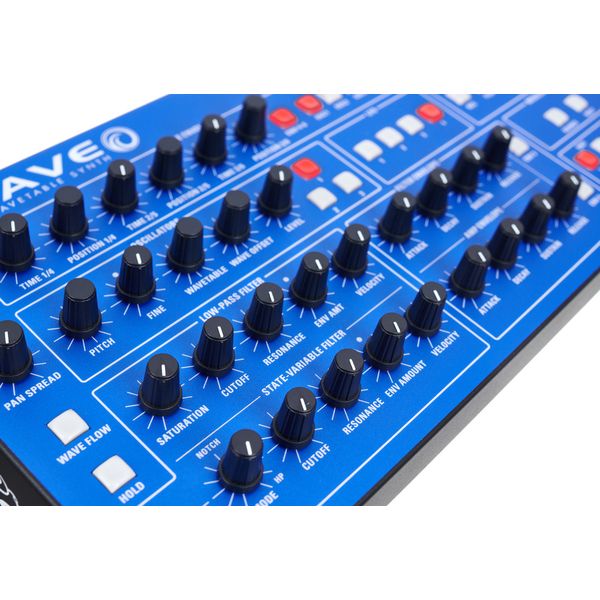
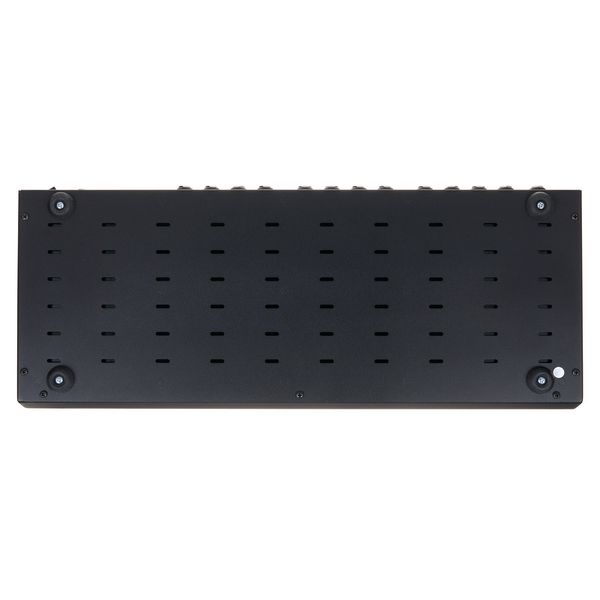
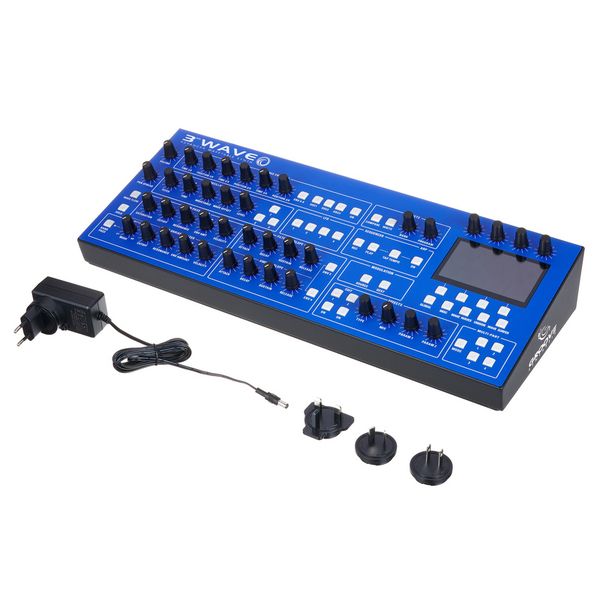


Hybrider Wavetable Synthesizer
- 24-Voice polyphony
- 4-Part multitimbral
- 3 Digital oscillators per voice
- 64 User wavetable positions with 48 wavetables with 64 waveforms per table
- 32 Original 8-bit wavetables of the PPG2 instruments
- 7 Modelled analogue waveforms (Sine, Saw, Triangle, Supersaw, Pulse, White Noise, Pink Noise)
- VCO sync
- Linear FM
- Analogue low-pass filter (Dave Rossum design)
- State-Variable Filter
- 4x ADSR+ delay envelopes
- 4x LF oscillators Triangle, Sawtooth, Reverse Sawtooth, Square, Pulse 1, Pulse 2, Pulse 3 and Random (S&H)
- 2 Digital effects processors (BBD, Stereo Delay, Tape Delay, Chorus, Phaser, Flanger, Distortion Pedal, Rotating Speaker, Ring Mod, Room Reverb, Hall Reverb, Super Plate Reverb)
- Integrated Custom Wavetable Maker 16-bit / 96 kHz (sample-to-wave function)
- Sequencer (4 multi-part song per programme, 24 sequences per song)
- Arpeggiator
- 16-Slot Modulation Matrix pro Multi-Part
- 41 Knobs and 43 buttons
- Pitch and Mod wheels
- 500 Presets (can be overwritten by user presets)
- Display
- Integrated power supply unit 100 - 240 V, 50 - 60 Hz, 65 Watt
- Dimensions (W x D x H): approx. 521 x 213 x 79 mm
- Weight: 4.63 kg
Connections:
- 8 Line outputs: 6.3 mm jack (4x stereo L/R )
- Stereo headphone output: 6.3 mm jack
- MIDI In / Out / Thru
- USB MIDI
- Line Eingang: 6,3 mm Klinke
- Pedal input: 6.3 mm jack for sustain / foot switch
- Input for volume and expression pedal: 6.3 mm jack
-
Available since November 2023
-
Item number 576463
-
Sales Unit 1 piece(s)
-
Design Desktop
-
Polyphony 24
-
Sound Generation Digital
-
MIDI interface 1x In, 1x Out, 1x Thru
-
Storage Medium Internal
-
USB-port Yes
-
Effects Yes
-
Arpeggiator Yes
-
Number of Analog Outputs 8
-
Digital Output No
-
Display Yes
-
Optional Expansions None
A compact wavetable flagship
The Groove Synthesis 3rd Wave Desktop brings the full sound architecture of the flagship wavetable synth into a compact desktop format, aimed at producers and sound designers who want to integrate the 3rd Wave's sonic capabilities into an existing studio or MIDI setup without an additional keyboard. With 24 voices and four-part multitimbrality, it runs the same powerful engine as the keyboard version – three oscillators per voice, dual analogue and digital filters, a 16-slot modulation matrix, and two effects slots per part. The difference lies in the concept: rather than functioning as a standalone performance instrument, the desktop module acts as a central sound source controlled via external controllers, DAWs, or complex MIDI environments.

)
Endless sonic possibilities
The 3rd Wave Desktop features exactly the same wavetable engine as the keyboard. Three oscillators per voice access classic 8-bit PPG wavetables, high-resolution 96kHz modern wavetables, and virtual analogue waveforms. There are 32 classic and 48 high-resolution wavetables, each with 64 waves, with Wave Flow handling smooth or stepped transitions between them. The Wavemaker tool creates custom wavetables directly on the unit from recorded or imported audio, including Serum-format wavetables. For sound-shaping, two filters run in series: a Dave Rossum-designed analogue SSI 2140 low-pass filter with variable saturation and self-resonance, and a digital state-variable filter covering low-pass, high-pass, band-pass, and notch modes. Two effects slots per part cover the full effects suite – BBD, Tape, and Stereo delays, Room, Hall, and Superplate reverbs, chorus, phaser, flanger, ring modulator, Leslie speaker, and distortion.
)
Integrated, not standalone
The 3rd Wave Desktop is designed for studio integration rather than standalone performance – controlled via external MIDI devices, MPE controllers, or directly from a DAW, with no integrated keyboard or pitch-bend and modulation wheels to duplicate hardware already on the desk. In contrast to its sibling, the 3rd Wave Desktop does without an integrated keyboard and dedicated performance controls such as pitch and modulation wheels – musicians play it via external MIDI devices, MPE controllers, or directly from a DAW. The streamlined front panel groups parameters into clearly structured sections, retaining hands-on access to the most-used controls while a button-and-soft-encoder system handles the rest without menu-diving. Four independent layers can be addressed multitimbrally via separate MIDI channels, each with its own stereo output for external mixing and processing – the same four pairs of unbalanced stereo outputs as the keyboard version, with no reduction in I/O.
)
Synthesis and sequencing
The 3rd Wave's internal sequencer allows notes, chords, and parameter automation to be recorded directly on the unit, with up to 24 patterns of up to 32 bars per pattern, chainable into songs. The Wave Envelope – a six-stage loopable envelope generator, three per part – sweeps through wavetables for evolving, organic sound movements. Four DADSR envelopes per part are switchable between modern exponential curves and PPG-style linear response. The modulation matrix offers 16 assignable slots, 12 fixed-source slots, 27 sources, and 114 destinations per part – identical depth to the keyboard version. Connectivity covers MIDI In/Out/Thru on 5-pin DIN, USB Type-B for MIDI and flash memory access, stereo audio input, four pairs of unbalanced stereo outputs, a headphone socket, and one sustain plus two expression pedal inputs.
)
About Groove Synthesis
Based in the San Francisco Bay Area, Groove Synthesis was founded by a team of synthesizer veterans who previously contributed to instruments made by AVID, Digidesign, Sequential, and Oberheim. Drawing on decades of expertise, they craft innovative instruments that blend emotional sound design with cutting-edge technology. Their flagship product, the 3rd Wave, is a hybrid wavetable synthesizer that merges analogue warmth with digital flexibility, inspiring musicians with rich, evolving textures. Born from a passion for classic synths, the 3rd Wave reimagines vintage concepts for the modern era, pushing creative boundaries.
PPG heritage and the Waveterm B update
The 3rd Wave concept draws directly from the PPG Wave 2 – the first commercially successful wavetable synthesizer, released in the early 1980s and revered for its harmonically rich 8-bit character. Groove Synthesis have gone to considerable lengths to make authentic PPG emulation possible: enabling PPG envelope mode switches from exponential to the more linear response of the original; voice drift reintroduces the oscillator instability that gave the PPG its organic quality; waveform smoothing corrects the pitch irregularities between notes – or leaves them in for a faithful recreation; the upper wavetable exposes the final four waveforms hidden by default, mirroring the original PPG behaviour. OS 1.8 added the Waveterm B sampling update – named after the PPG's original sampling companion – allowing oscillators to play back multisamples with up to 3.3MB of RAM, approximately 35 seconds at 48kHz. On the desktop, the full depth of this engine is accessible through a carefully considered panel that edits just as fluently as the keyboard – a rare achievement in desktop synth design.