


E
Great product but not my thing...
I really had high expectations for this product. Featurewise it's got everything and it's well thoughtout....expect for those players who like to have a clean tone.....you can do that but the overall output of the irx gets way too low. The boost on that channel also is too weak for getting it into crunch territory....the lead channel is nice but the tonecontrols lack the ability to get a more mellow, round tone....presence and thump controls as well as other ir's that are excessable through the computer don't change things enough in this regards....it's greatly built, very fine features etc but it's not for me in terms of delivering the tones I'd like to hear....
16
5
Report
#
The IR-X Experience
I ordered Friedman IR-X from Thomann and it arrived in Dubai flawlessly and on-time. As my first order from Thomann, it was a very good experience.
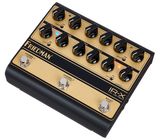
Now let's talk about the IR-X. I have used this unit for over 8 months now and I am really impressed by it. Having used digital modelers for many years, the best thing I like about this unit that it has no digital screen and menus to scroll through. You can dial in EQ and Gain instantly. This helps specially when you have to perform at different venues and need to adjust your EQ and Gain on the fly. Having two channels (low & high) with their own boost setting is very helpful and avoids the need to have a separate boot pedal. I don't use any modulation effects so my signal chain consists of an Overdrive > IR-X > FOH (That's all). I use Reverb/Delay in the loop. Just three pedals and I can get all the tones I need to play Classic Rock and Blues. IR-X is very dynamic, which means it reacts very well to light/hard picking and guitar volume control.
I mostly use channel 1 on the IR-X as a pedal platform. It produces clean to slightly overdriven tones. I prefer getting more saturation through stacked OD pedals, this helps me to add gain, saturation and volume in steps. The beauty of using OD pedals is that you can change the character of the amp. For example, if I use a Dirty Shirley OD pedal in the front then I can make the IR-X sound like a JTM 45.
Whilst I love the IR-X and how it sounds, there are some areas where IR-X could have been even better.
1) The pots on the IR-X are very soft which means they have little to no resistance. I am not sure why Friedman could not get better pots same as we see on Boss and other pedals. Some people add a rubber o-ring under the knobs to create resistance or add an additional protective cover on top. I have seen similar units with better ergonomics.
2) The plastic knobs could have been of better quality; like we get on Marshall amps. To me they look and feel cheap for a US$ 500 unit.
In conclusion IR-X is a great unit and I love it for what it is. However, I also enjoy using ToneX One as a pedal platform, which can offer a lot more than the IR-X.
Now let's talk about the IR-X. I have used this unit for over 8 months now and I am really impressed by it. Having used digital modelers for many years, the best thing I like about this unit that it has no digital screen and menus to scroll through. You can dial in EQ and Gain instantly. This helps specially when you have to perform at different venues and need to adjust your EQ and Gain on the fly. Having two channels (low & high) with their own boost setting is very helpful and avoids the need to have a separate boot pedal. I don't use any modulation effects so my signal chain consists of an Overdrive > IR-X > FOH (That's all). I use Reverb/Delay in the loop. Just three pedals and I can get all the tones I need to play Classic Rock and Blues. IR-X is very dynamic, which means it reacts very well to light/hard picking and guitar volume control.
I mostly use channel 1 on the IR-X as a pedal platform. It produces clean to slightly overdriven tones. I prefer getting more saturation through stacked OD pedals, this helps me to add gain, saturation and volume in steps. The beauty of using OD pedals is that you can change the character of the amp. For example, if I use a Dirty Shirley OD pedal in the front then I can make the IR-X sound like a JTM 45.
Whilst I love the IR-X and how it sounds, there are some areas where IR-X could have been even better.
1) The pots on the IR-X are very soft which means they have little to no resistance. I am not sure why Friedman could not get better pots same as we see on Boss and other pedals. Some people add a rubber o-ring under the knobs to create resistance or add an additional protective cover on top. I have seen similar units with better ergonomics.
2) The plastic knobs could have been of better quality; like we get on Marshall amps. To me they look and feel cheap for a US$ 500 unit.
In conclusion IR-X is a great unit and I love it for what it is. However, I also enjoy using ToneX One as a pedal platform, which can offer a lot more than the IR-X.
3
0
Report
e
expected more (especially for the price I paid)
The IR-X does have the typical Friedman sound: good high-gain modded Marshall sound and mediocre low-headroom clean sound that doesn't even crunch particulary well and generally struggles to keep up. In that sense, channel one is good as a pedal platform for drive pedals, but don't expect much more of it - what you're buyng here is the high-gain channel two, which is actually pretty good at medium-gain sounds too. The sound is and does feel like true tube, as much as any device that's not an actual tube amp can. However, definition in the higher gain range could be better, and, personally, no matter what guitar i plugged into it (single coils, low, medium or high output humbuckers), I never achieved the balance of sustain and clarity that I'm looking for in a high-gain sound, especially when it comes to recording, which is the main purpose I got it for. The boosts, while they work, are subpar as compared to most standalone overdrive pedals (a TS MINI in the front did a much better job in getting a good lead sound out of channel two than the internal boost circuit).
The power amp sim and IR's are decent enough, although most positive reviews of the pedal (like Pete Thorn's, etc.) actually use externally loaded IR's for a reason. The DI out is good. The headphone out was inevitably noisy, I never quite understood why.
The foot switches have a latency, which in my opinion makes the device barely usable as a live tool, if you would want to go between channels one and two "on the spot". In fairness, this is not a problem unique to this device (I have also encountered that with one of the bigger Boss pedals that have the same type), and it was explained to me that, because of the noiseless design, they trigger the changes not upon being engaged, but upon being released. Personally, I doubt it's just that and couldn't help feeling like the device was just too slow in "computing" the change. Anyway, I found it counterintuitive to my playing and couldn't really get used to it at all.
The controls work fine and have a decent amount of range to them, but the knobs are too light for my taste and kept on moving upon the slightest unintentional contact (by a cable, my foot, etc.).
The latter two observations lead me to qualify this more as a desktop rather than as a live tool, which is stupid, considering it has the infrastructure to work like one.
Overall, this is certainly one of the better attempts at amp simulation we have seen in recent years, but has its inherent limitations and some design and quality flaws, which made me feel like getting far less than what I expected from a Friedman, bearing a Friedman price premium. And here is my last but not least gripe with this: I bought it in the first months after its release for 595 €. Less than a year later, it was already selling way under 500 €. It is now 444 €. Yes, I know you sometimes pay a novelty premium immediately after a product is released and prices may see some adjustment down the road ... but this is huge! I mean, it's huge like it's almost insulting. 25% of first-hand price erosion in less than 24 months for a big-name product like that is to me the last in a series of bitter lessons to never again go for the hype of big names and YouTube "marketing" like that.
The power amp sim and IR's are decent enough, although most positive reviews of the pedal (like Pete Thorn's, etc.) actually use externally loaded IR's for a reason. The DI out is good. The headphone out was inevitably noisy, I never quite understood why.
The foot switches have a latency, which in my opinion makes the device barely usable as a live tool, if you would want to go between channels one and two "on the spot". In fairness, this is not a problem unique to this device (I have also encountered that with one of the bigger Boss pedals that have the same type), and it was explained to me that, because of the noiseless design, they trigger the changes not upon being engaged, but upon being released. Personally, I doubt it's just that and couldn't help feeling like the device was just too slow in "computing" the change. Anyway, I found it counterintuitive to my playing and couldn't really get used to it at all.
The controls work fine and have a decent amount of range to them, but the knobs are too light for my taste and kept on moving upon the slightest unintentional contact (by a cable, my foot, etc.).
The latter two observations lead me to qualify this more as a desktop rather than as a live tool, which is stupid, considering it has the infrastructure to work like one.
Overall, this is certainly one of the better attempts at amp simulation we have seen in recent years, but has its inherent limitations and some design and quality flaws, which made me feel like getting far less than what I expected from a Friedman, bearing a Friedman price premium. And here is my last but not least gripe with this: I bought it in the first months after its release for 595 €. Less than a year later, it was already selling way under 500 €. It is now 444 €. Yes, I know you sometimes pay a novelty premium immediately after a product is released and prices may see some adjustment down the road ... but this is huge! I mean, it's huge like it's almost insulting. 25% of first-hand price erosion in less than 24 months for a big-name product like that is to me the last in a series of bitter lessons to never again go for the hype of big names and YouTube "marketing" like that.
0
0
Report
M
Nice, natural amp sound in a simple unit
The lack of options is its main asset. Just like an amp: plug and play.
For those who hate complicated modellers it is a welcome difference.
Option paralysis is real - and limitations can be your best friends in finding creativity.
Me personally I use it along with Helix as another flavour. And always wanted a Friedman amp, but for various reasons it did not make sense. Thx to this unit it's now possible
For those who hate complicated modellers it is a welcome difference.
Option paralysis is real - and limitations can be your best friends in finding creativity.
Me personally I use it along with Helix as another flavour. And always wanted a Friedman amp, but for various reasons it did not make sense. Thx to this unit it's now possible
0
0
Report