



Brass instruments are instruments that are made of brass, right? Sounds logical but it isn’t true in every sense and very often woodwinds such as the saxophone and even clarinets are mistakenly thrown into the brass category. Let’s discuss a selection of the most common brass instruments: What are their peculiarities? Here are a few tips, thoughts and sound samples, just for you!
#KissMyBrass
1. Cornet – universally popular
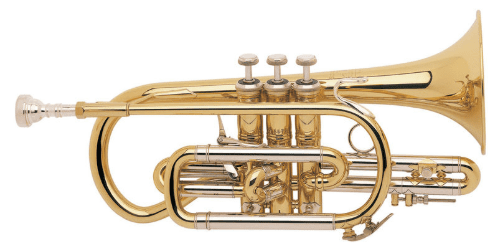
Maybe it’s because the cornet is the smallest of the traditional brass instruments, but one thing is clear: it is the most played instrument among brass musicians. About 30% are using this icon of brass instruments. The cornet has a relatively lyrical, velvety and round sound and blends harmoniously into the brass section. A slight distinction is found between the smaller Eb cornet and the larger Bb cornet (listen to the audio sample below). For high notes the cornet reaches its natural limits. In addition, many musicians agree that it is difficult to play because of the deeper, V-shaped cup in the mouthpiece.
You are currently viewing a placeholder content from YouTube. To access the actual content, click the button below. Please note that doing so will share data with third-party providers.
2. Trumpet – in the first row

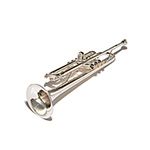
The trumpet, a close relative of the cornet: The playing style is similar, almost identical, apart from the somewhat different approach. The trumpet is longer and delivers a brighter, more present and clearer tone. For this reason alone it is preferred in the brass section as a soloist. And in terms of volume, the trumpet is also far more dominant. The notes snap less easily than with a cornet, making jazzy, “half-muted” and “coloured” notes easier to play.
You are currently viewing a placeholder content from YouTube. To access the actual content, click the button below. Please note that doing so will share data with third-party providers.
3. Flugelhorn – the versatile, well-sounding one

Another relative of the brass family is the flugelhorn. Basically, the style of playing also does not differ from the trumpet or the cornet, however this claim is debatable. The most significant difference lies in the mouthpiece. A flugelhorn mouthpiece, with a comparatively large inner bore, leads to higher air consumption and air use. Actually, it should swing the sound pleasantly due to the lower blowing resistance.
You are currently viewing a placeholder content from YouTube. To access the actual content, click the button below. Please note that doing so will share data with third-party providers.
4. Alto / Tenor Horn – the joyful harmony
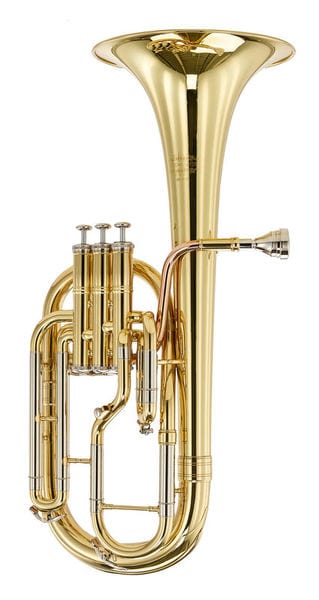
A pretty good-natured comrade is the Tenor Horn (usually in Eb or Bb); in terms of its sound character, it’s not usually a brass instrument that is put in the foreground. Rather, it is mostly used as a typical accompanying instrument. On the Eb horn, the bell and the mouthpiece are both directed upwards; therefore it is easy to play sitting down. The tenor horn acts as a bridge in the brass section, adding beautiful harmony to the composition.
You are currently viewing a placeholder content from YouTube. To access the actual content, click the button below. Please note that doing so will share data with third-party providers.
5. Euphonium – good voicing in the mid-tone section

The euphonium sings one octave lower than the trumpet and one higher than the tuba. This instrument requires a special mouthpiece with cup sizes that are usually deeper and more conical in nature. The most important difference to other brass instruments is the euphonium’s compensating mechanism: Depending on the model, three or four valves are installed and this makes for intonation which is very good and differentiated.
You are currently viewing a placeholder content from YouTube. To access the actual content, click the button below. Please note that doing so will share data with third-party providers.
6. Trombone – the infinite
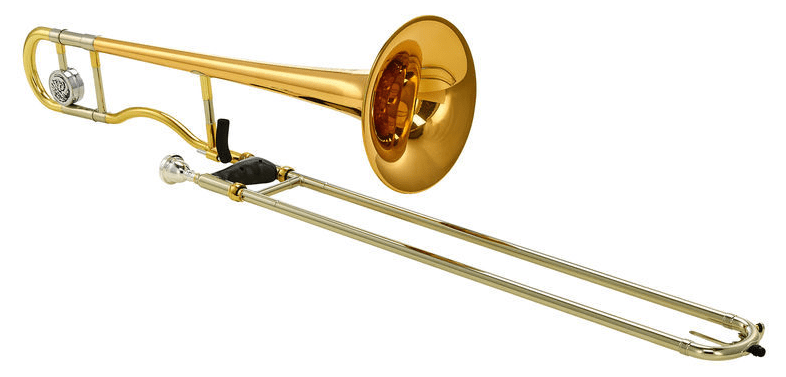
A typical instrument from the brass section is the trombone. It is generally said to be the easiest instrument of the brass family. The tones are not controlled by valves, but by the slide instead. And that not only allows these typical drawn tones, but also intermediate ones. In addition to the mastery of breathing and technique, having an excellent ear for pitch is one of the most important requirements.
You are currently viewing a placeholder content from YouTube. To access the actual content, click the button below. Please note that doing so will share data with third-party providers.
7. Tuba & Sousaphone – from deep down
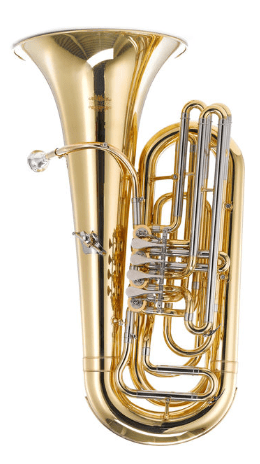
The sounds that come from a tuba are thunderous and other-worldly. Some people are even convinced that they come from Heaven above, which is ironic because the register is at the very bottom of the brass section. The special feature of these beasts is that they have three to six valves and a particularly wide scale length and thus a much wider bore. It is played via a wide and deep (cup– or bowl-shaped) mouthpiece. There are many different designs, from the marching tune of the sousaphone to earth-shaking tones of the contrabass tuba (BB-flat or CC tuba, see video below), which has at least a length of 580 cm. That’s almost six meters of brass in your hands!
You are currently viewing a placeholder content from YouTube. To access the actual content, click the button below. Please note that doing so will share data with third-party providers.
Consultation
If you still have questions or would like to be advised, then we are gladly there to help! Come by our brass section in Treppendorf or contact us by e-mail or by telephone: (09546) 9223 26!
👉 To all brass instruments on thomann.de
From 24 to 30 April 2019 #KissMyBrass is all about brass instruments. On Facebook and Instagram and here on the t.blog you will find exclusive deals, helpful articles and all kinds of entertaining content.








Comments 31