Want to play a string instrument but don’t know where to begin? ▶︎ From selecting the right size to mastering your first notes, here are essential tips to start your musical journey with confidence! ✓
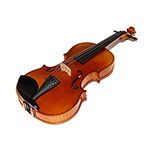
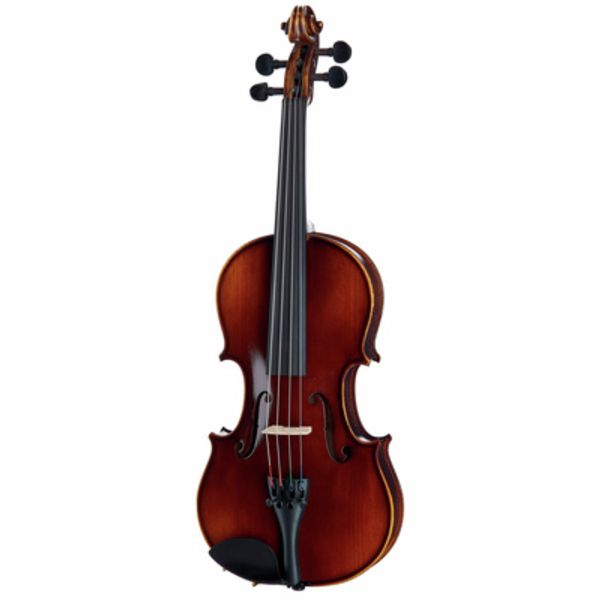
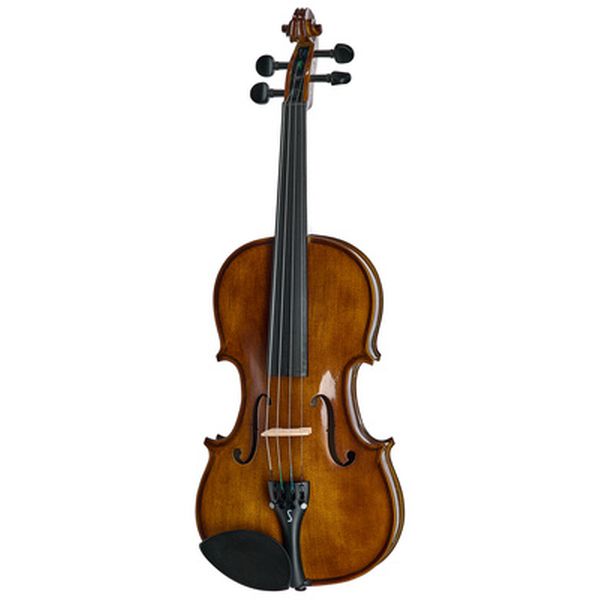
The violin and its relatives from the string family are still among the most popular instruments, not only for beginners with an affinity for classical music. String instruments convince with their melodious sound character and immense versatility. We hope that our tips for beginners will help you take your first steps into the wonderful world of string instruments…
1. The right size of the instrument is crucial for getting started
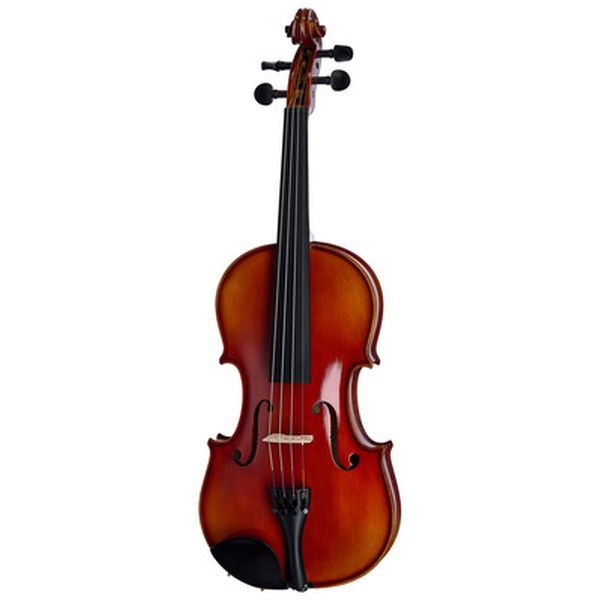
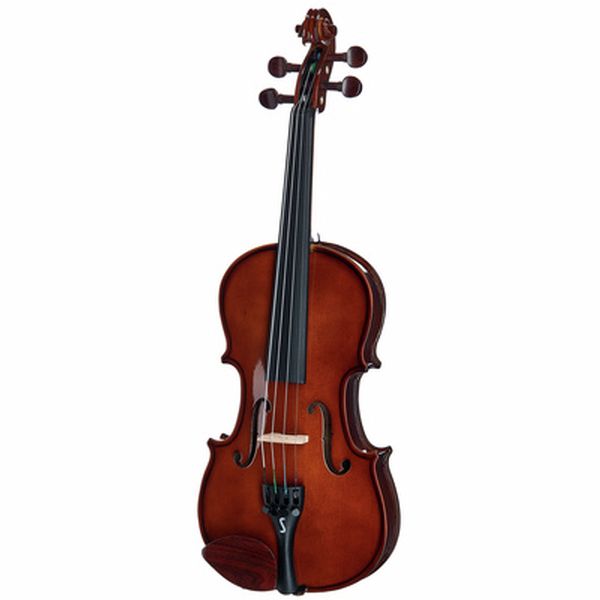
In fact, the violin, for example, is an instrument that many music students start out with at an early age. So there are various different instrument and bow sizes, tailored to the respective age or body size and the length of the arms, hands and fingers. Ultimately, the decisive factor is the arm length. Here is a table that parents and beginners can use as a rough guide:
At what age can you start? The rule of thumb is that the bigger the instrument, the later kids should start using it. It is simply a question of the manageable dimensions. Here are just a few recommendations:
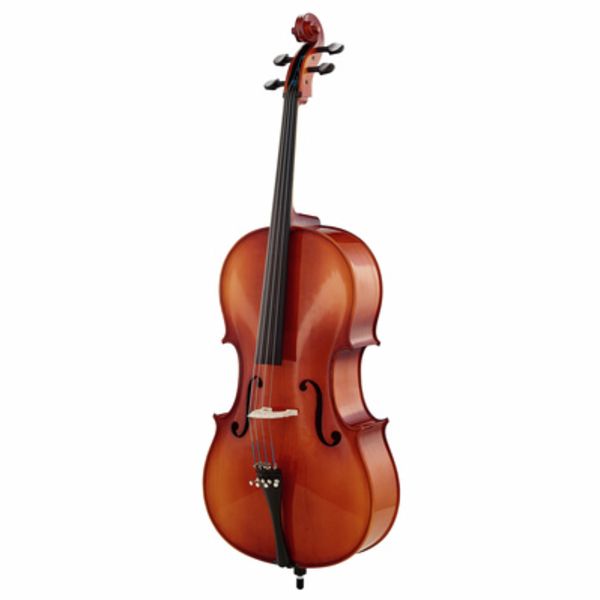
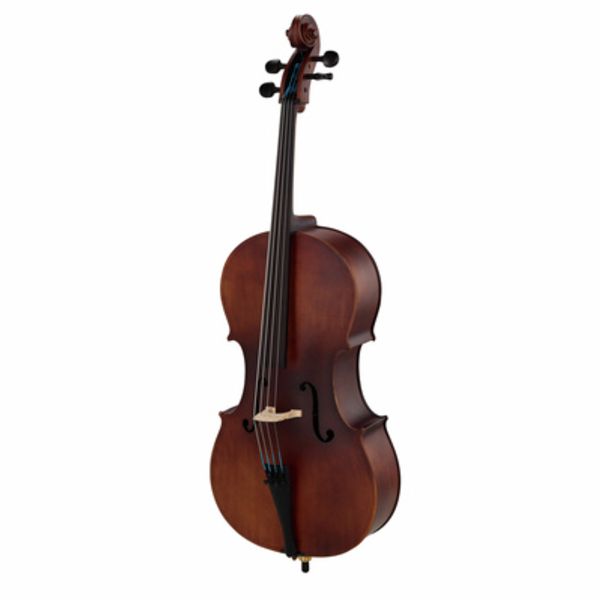
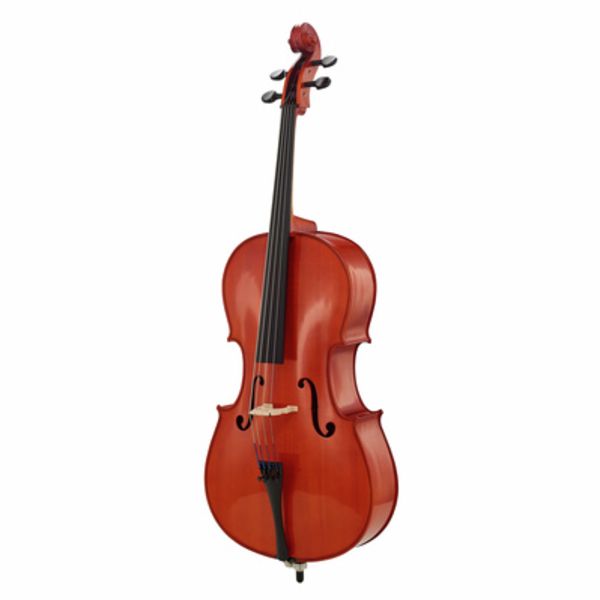
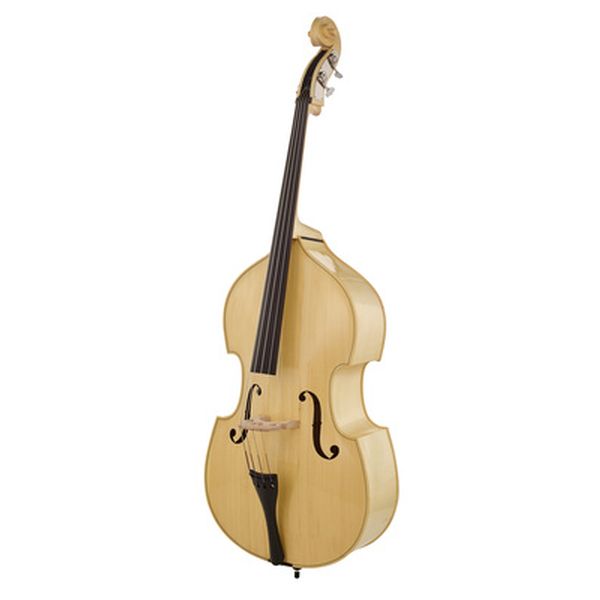
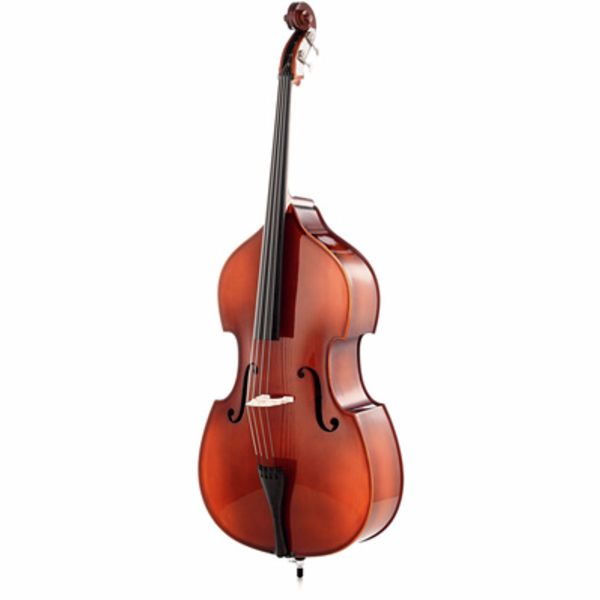
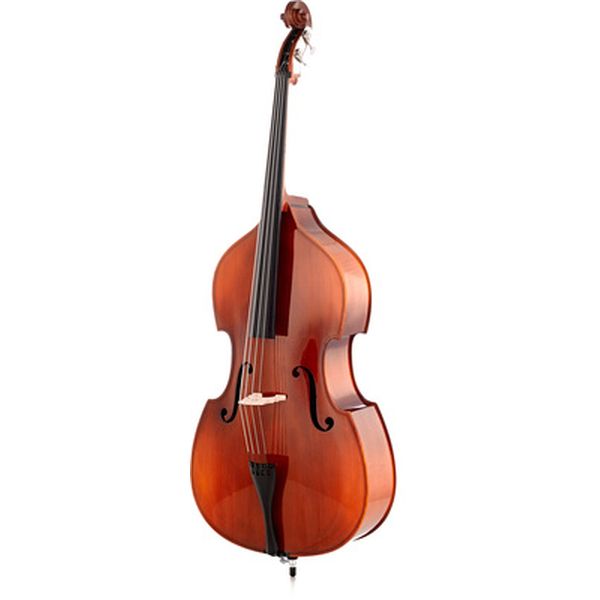
Violin: The recommended starting age for the violin is around 4 years Cello: With the cello you should wait a year or two, i.e. start at around 6 or 7 years of age Double bass: The double bass requires a bigger body size; at around 10 years of age
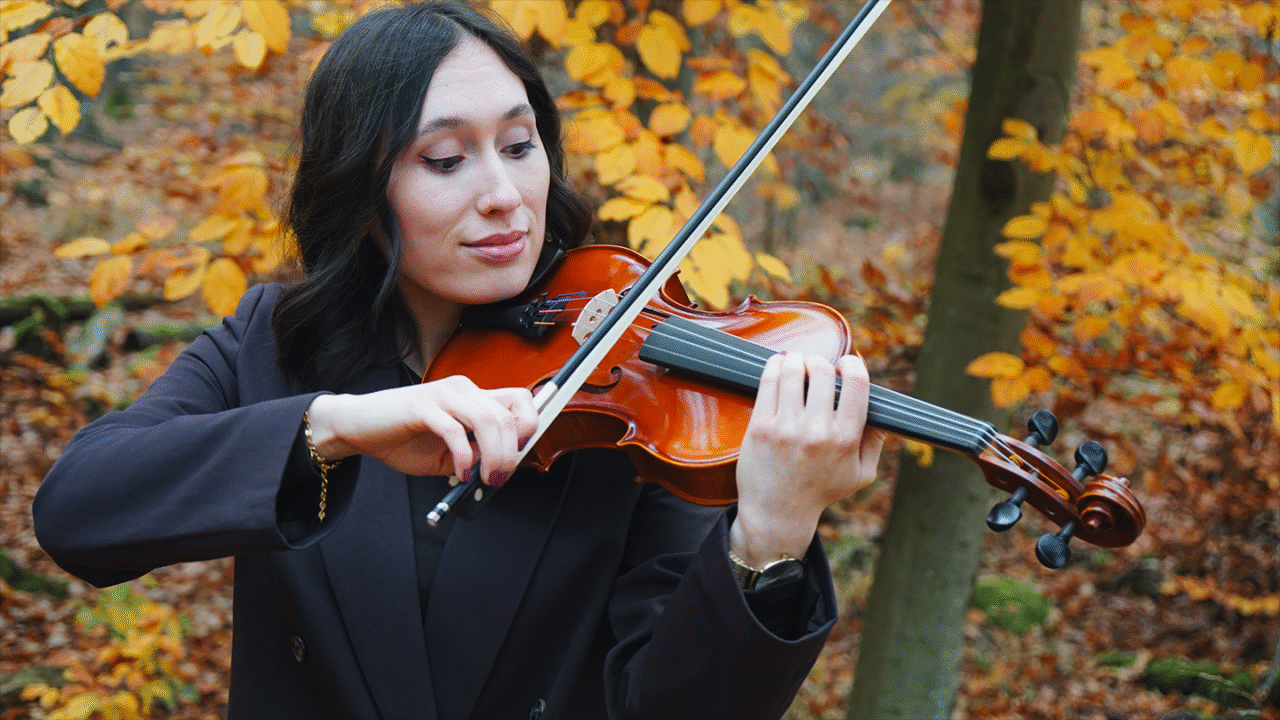
With string instruments, the support of a music teacher is extremely important, if not indispensable. Grasping the bow correctly, holding the arm correctly and thus getting a straight line is a challenge that should not be underestimated at the beginning. And at the same time you should also look at the notes. An accomplished music teacher guides you, corrects postural errors and motivates you to achieve further success.
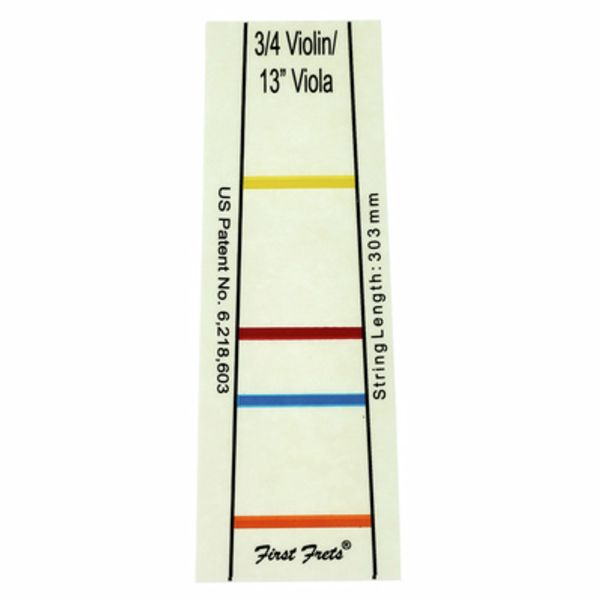
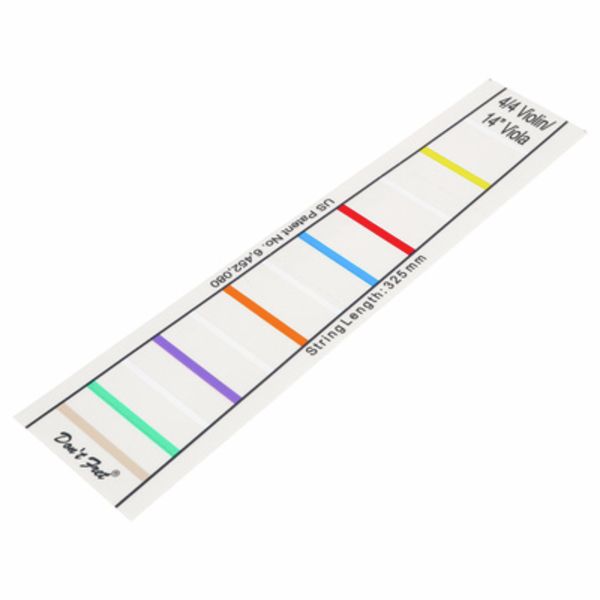
2. Adhesive dots / fingerboard markings
The right tool for getting started has been found, the question remains what the first steps look like so that you can make friends with your new darling and achieve motivating learning successes quickly. In contrast to a guitar, for example, a string instrument does not have any frets that you can use to orient yourself in order to play exactly the right notes. You can bridge this with small adhesive dots or afingerboardmarker that you place on the fingerboard. At thomann.de we offer a large selection of different fingerboard markings, just browse this link.
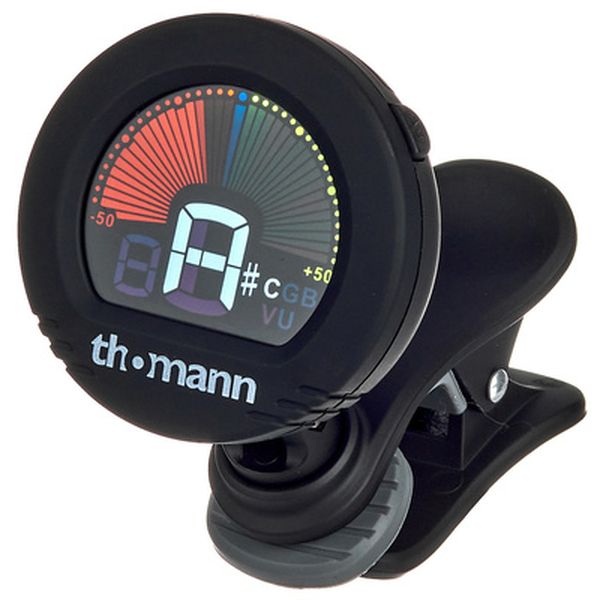
3. Tune the strings precisely, initially with a tuner
Before you start, the instrument has to be carefully tuned, by the way, not only before you play, but also from time to time to control it. One day you will do this purely by ear and a given reference tone. In the beginning it is helpful if you use a digital tuner for this. By the way, you train your hearing while tuning regularly.
4. Draw a bow, use rosin, strike out the first notes
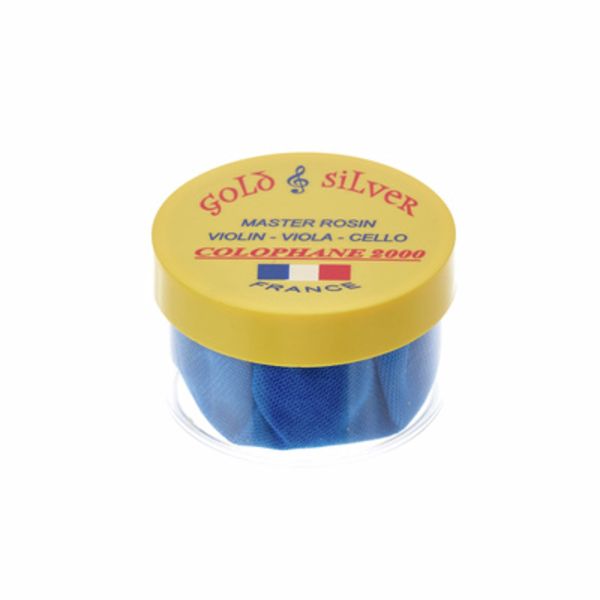
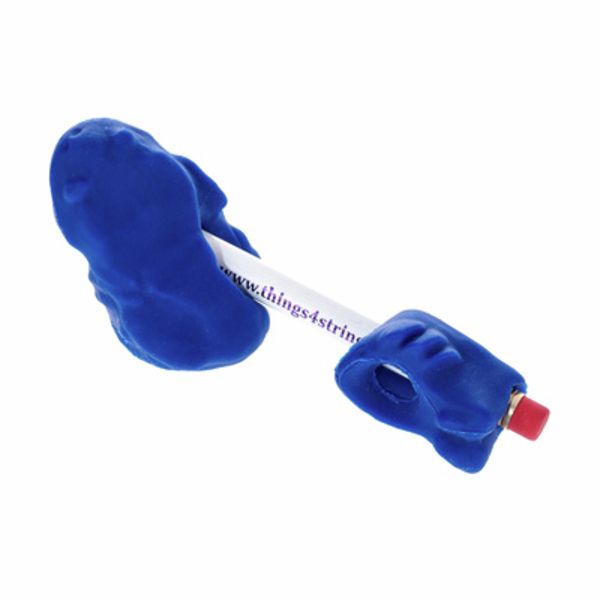
In the next step you will get to know the bow, which is nothing less than an arm extension for your expressive game. So that the bow hair has sufficiently strong adhesion when you stroke the strings, rub the hair – not yours (!) – with a bow resin, the so-called rosin.
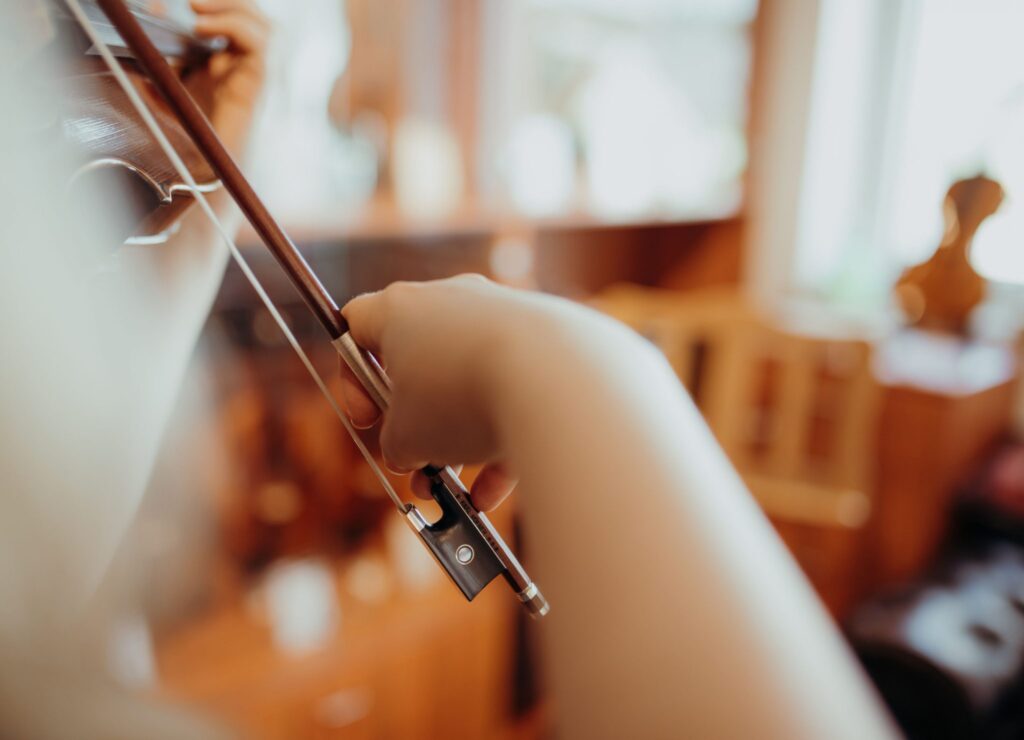
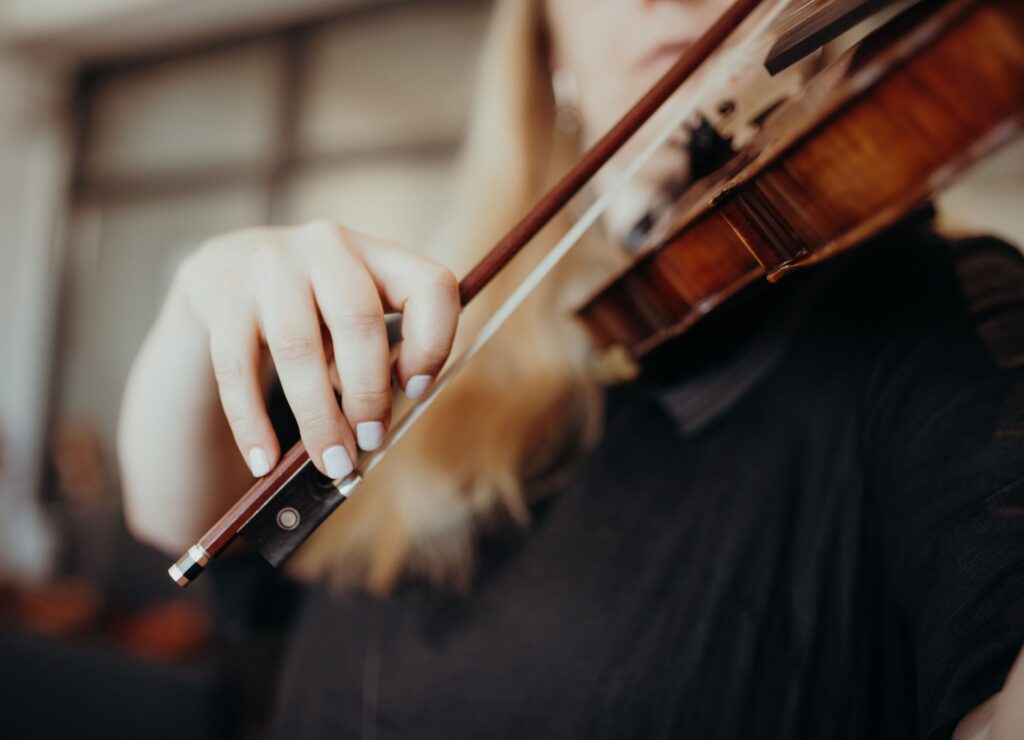
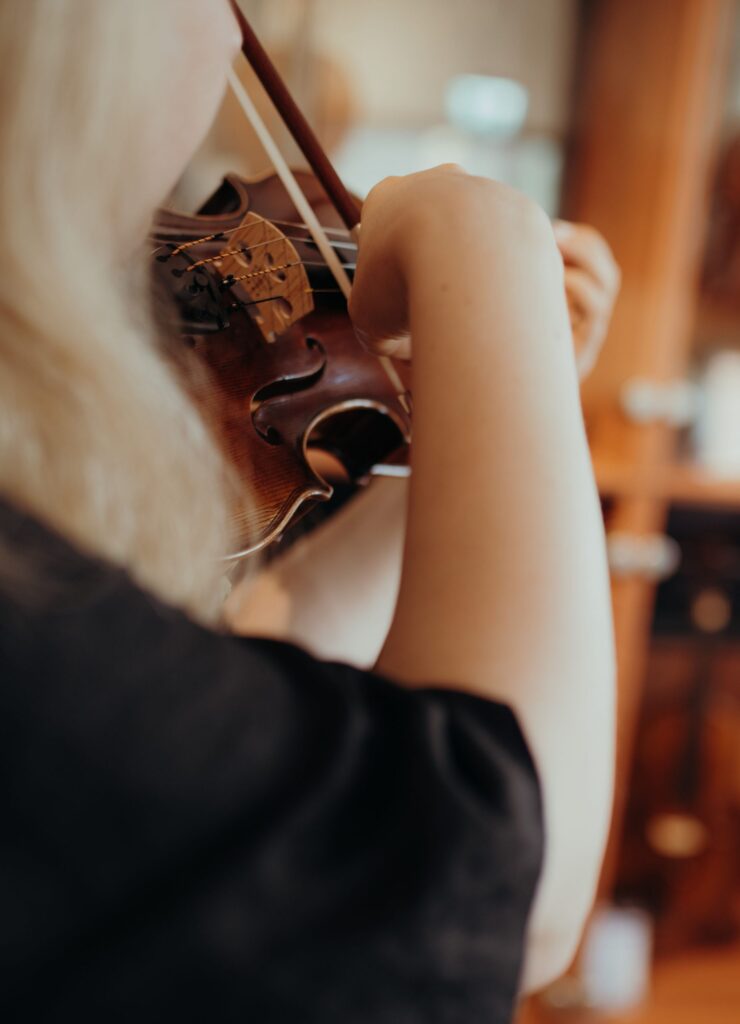
We dedicate ourselves to the correct bow position: Strangely enough, it has to be as loose as it is stable so that a pleasant tone can be created. To do this, form a circle with your middle finger and thumb. The bent thumb touches the middle finger on the outer finger joint. Now you push the rod of the bow between your fingers. The ring finger and middle finger are bent side by side and placed on the floor bar. In the next step you lift your elbow slightly, whereby the index finger approaches the arch pole and is placed with the middle phalanx on the arch pole. Now the little finger is also bent on the bow stick so that this smallest of the fingers bears the weight of the bow. Done? Excellent!
Very mportant goal: the straight line
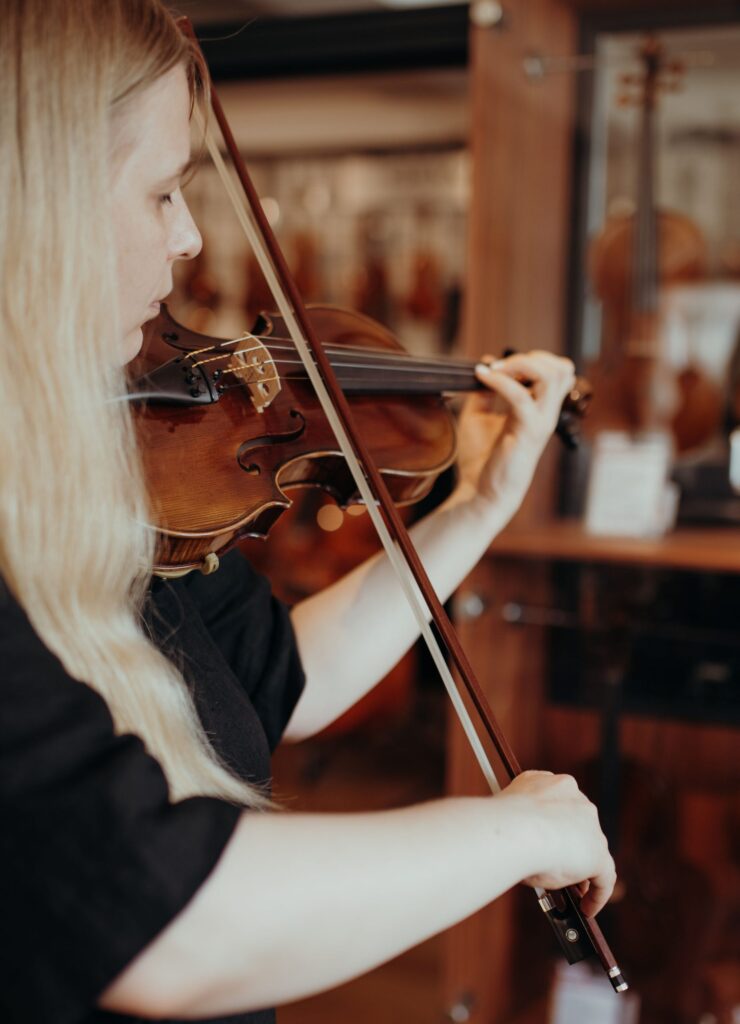
In the beginning, one of the most important goals is to learn a straight line. First, take the bow in your guide hand, do not just let it fall onto the strings like a saw, but actively guide it. Now you stroke with the bow in alternating long and short movements over a string that is not fingered and develop a feeling for the necessary and not excessive pressure until this sound is pleasant and evenly loud over the entire stroke.
Straight line / bow posture
Be careful not to strike two strings at the same time. The correct finger and arm position must always be checked, as well as the straight line. Don’t worry: at some point it will all be programmed into your “muscle memory” and will work automatically.
The preparations before and for the first tone are:
Place orientations in the form of adhesive dots on the neck
Tune the violin precisely
Draw a bow and coat the bow hairs with a little rosin
Grip the bow correctly, see above
Pay attention to a straight line and correct arm posture
Experience and feel the bow on the strings
5. Stay loose with gripping hand / Place fingers on meticulously
And the gripping hand comes into play. The orientation points are set, you only take a few notes with which you can play a simple melody. First try to stay on one or two strings at most and play the notes alternately without major interruptions. You will achieve your goal with regular, if possible daily, practice. Remain deliberately reserved and simple. Much more important than the speed is to play really nice-sounding and cleanly intoned notes:
Initially only play a few notes with the gripping hand and pay attention to the harmonious sound Check the intonation of the individual notes over and over again Play the first melodies slowly and precisely Pay attention to the correct finger, arm and body position Practice regularly, ideally daily
You hold a valuable instrument in your hand, one which should be looked after and protected. You should therefore take into consideration appropriate care products and consumables such as fresh strings and rosin right from the start. And so that the instrument can be transported undamaged by the natural elements, a case or gig bag is an indispensable accessory.
If you have any questions, you can always contact us. The string instruments department is happy to provide advice, information and helpful tips on everything to do with the first string instrument. And that without any obligation. No question about it, we look forward to every new family member in the musical world of string instruments!
For all string instruments, the basic principle is that their size must be based on the body structure and development of the child. Therefore, when buying, the advice of an experienced teacher or a visit to the specialist departments of our store in Treppendorf, where our employees help new musicians to make the right choice, is ideal.
If you can’t come by, you are welcome to give us a ring, use our live chat on thomann.de or send us an email. All contact details below:
Musikhaus Thomann Hans-Thomann-Str. 96138 Burgebrach / district Treppendorf
Your feedback
Are you planning to learn a string instrument or can you already master one? If so, do you have any tips for beginners? We would be happy to receive your comments!
You are currently viewing a placeholder content from Facebook. To access the actual content, click the button below. Please note that doing so will share data with third-party providers.
You are currently viewing a placeholder content from Instagram. To access the actual content, click the button below. Please note that doing so will share data with third-party providers.
You are currently viewing a placeholder content from TikTok. To access the actual content, click the button below. Please note that doing so will share data with third-party providers.
You are currently viewing a placeholder content from X. To access the actual content, click the button below. Please note that doing so will share data with third-party providers.














Comments 2