


Synapse Audio Dune 3

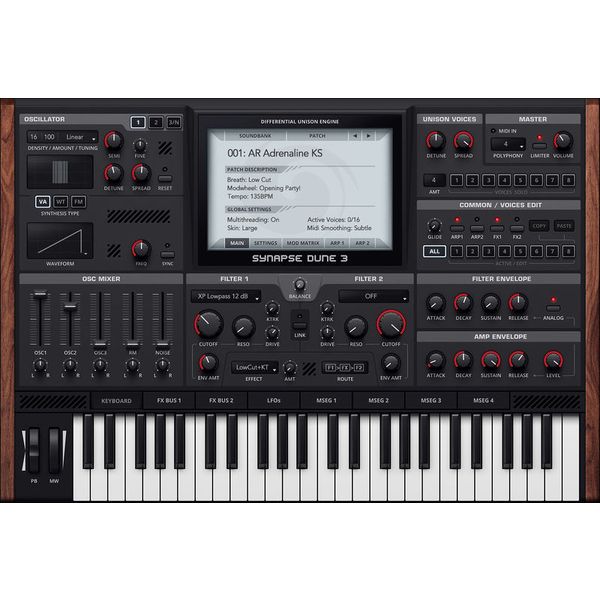
Virtual synthesizer (download)
- Flexible synthesizer with virtual-analog oscillators, wavetable and FM synthesis
- 2 parallel tone generators with 32 oscillators each, 8-layer unison
- Extensive wavetable editor
- 16-voice polyphony – for a total of up to 520 oscillators
- Dual filter with balance and serial or parallel routing
- Playable zero-delay feedback filter
- 4 graphic envelopes (MSEG)
- 3 LFOs
- Versatile 32-slot modulation matrix
- 2 master effect buses with 9 effects each
- Innovative arpeggiator with MIDI import
- Over 1000 presets
- Shipping Format: E-Mail
- Copy Protection: Online Activation
- Simultaneous Activations: 3
- Windows: from 7
- Mac OS (64 Bit): from 10.11
- CPU min.: Quad Core 3 GHz
- CPU compatibility: Apple Intel, Windows AMD, Windows Intel
- RAM min.: 8 GB
- add. System requirements: Internet Connection
- AAX native 64-Bit
- AU 64-Bit
- VST2 32-Bit
- VST2 64-Bit
- NKS
-
Available since December 2018
-
Item number 454776
-
Sales Unit 1 piece(s)
-
Single/Bundle article Los artikel
-
Akustik Keys/Pianos No
-
Beat production / Drum machines No
-
Wind Instruments No
-
Cinematic / Effects No
-
Chorus / Vocals No
-
Drums / Percussion No
-
E-Pianos No
-
Ethno / Folk No
-
Guitars/plucked instruments No
-
Loops/Construction-Kits No
-
Orchestra Instruments No
-
Organs No
-
String Bass No
-
Sampler No
-
String Instruments No
-
Synthesizer Yes
-
Vintage Instrument No
-
Hardware Controller No
-
Download Yes
-
MPE Yes
-
NKS Yes
-
The gold standard for EDM
Synapse Audio's Dune 3 is a virtual analogue synthesizer plugin that has effectively established itself as the industry standard for Dance, Techno, Trance, and more – because Synapse continues to consistently maintain, upgrade, and evolve their products to keep them at the cutting edge of modern electronic music. Dune's hugely flexible form of sound generation allows musicians of all kinds to create a peerless spectrum of sounds, with a character – perhaps best described as "hardness" – that's often better suited to EDM styles played at dancefloor volume than emulations of a vintage analogue synth. Version 3 of Dune, which has already been further improved and adapted to today's tastes with numerous sub-updates, supports multiple synthesis types and sample import functionality, as well as being capable of generating an extremely high number of oscillators.
)
Oscillation galore
Synapse Audio Dune 3 features two main oscillators per voice with VA, wavetable, and FM algorithms, which can be multiplied up to eight times and further scattered via detune and spread. In addition, the package includes a third, auxiliary oscillator and a noise generator. If all these options are activated, fully utilising all eight layers and the unison function, an incredible 520 oscillators can be combined in a single voice. On top of all that, DJs can also add to the vast selection of preset wavetables with their own custom waves and wavetables, with the third oscillator even capable of importing and looping .wav files. The filter section consists of two multimode filters with over 30 modes and an extra effect, all of which can be arranged in multiple routings. To round things off, Dune 3 offers two FX buses, multistep envelopes, LFOs and ADSR envelopes, a mod matrix, and two arpeggiators/sequencers per patch.
)
An electro El Dorado
Synapse Audio Dune 3 comes equipped with a catalogue of over 1,000 presets: Even if producers were to simply make use of and slightly modify this library, they could create literally countless tracks. However, this treasure trove is mere fool's gold compared to the potential inherent in Dune 3's sound generation capabilities: The possibilities offered by the wavetable editor alone provide an endless supply of source material for percussive basses, spectral pads, and unmistakeable lead sounds, which can be optimally combined both with the VA and FM algorithms and users' own samples. Together with the comprehensive (not to say complex) filter section and extensive modulation options, ambitious sound designers have an enormous palette at their disposal. Admittedly, charting and navigating this veritable El Dorado does require users to get more than just a feel for the material, but thankfully the video tutorials provided by Synapse Audio are an excellent starting point.
)
About Synapse Audio
Synapse Audio is a software developer specialising in EDM-focused synthesizers. Initially known as Sonic Syndicate, the company rebranded in 2002 following the launch of the Orion mini-DAW. Orion integrated multiple synthesizers, drum machines, and samplers into a standalone production environment. Synapse Audio later released the versatile and powerful Dune synthesizer, which remains a favourite among EDM producers, consistently updated to meet evolving needs. Additional plugins, such as Obsession and The Legend, are praised for their authentic emulation of vintage analogue synthesizers, while maintaining unique, modern identities that set them apart in the digital music production landscape.
)
Awesome waves
The wavetable editor offers producers a variety of tools for creating custom wavetables and waveforms: They can draw each new waveform freehand or precisely with a ruler, set multiple points that the software then connects automatically, or define a new wavetable using Dune's harmonic editor, which allows the musically-inclined to specify overtones in immense detail, with exact control over level and phase. Although the custom wavetables each consist of only three waveforms, the powerful morph function can interpolate a number of intermediate stages. Similarly, the wavetables and filters are all ideal raw material for the plugin's complex modulation curves. Like the wavetables themselves, users can also define multiple points for the multistep envelopes, including the application of exponential curves. Finally, the loop function makes it possible to create rhythmic, synchronisable patterns that producers can then save for later use.
