To the page content
Gifts for Musicians

Gifts for Musicians

This product is one of many gift ideas that our experts have put together. Find the perfect gift for every musician and music enthusiast in our carefully selected categories. From instruments to audio equipment – make this season extra harmonious!

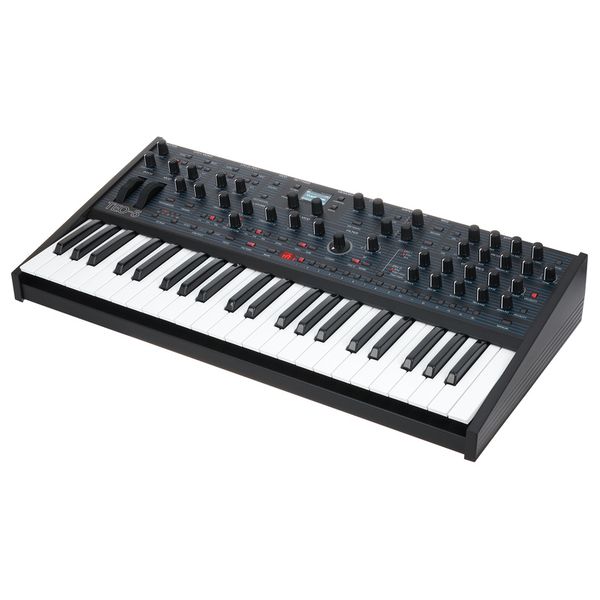
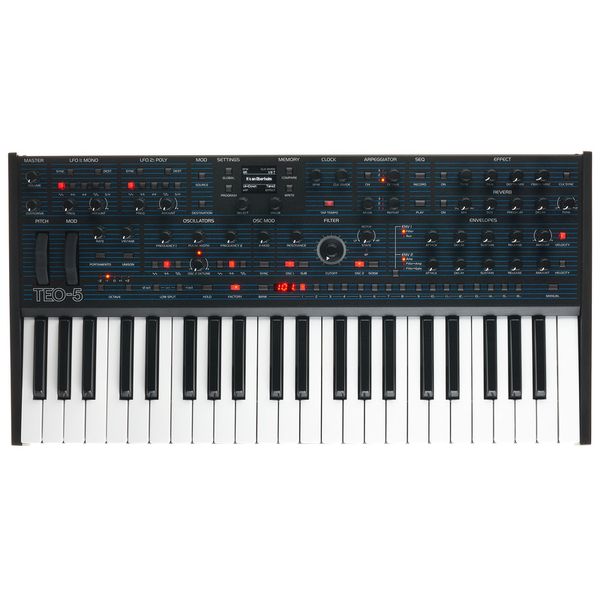
5-Voice Polyphonic Analogue Synthesizer

  • Semi-weighted Fatar keyboard with 3.5 octaves, 44 keys with channel (mono) aftertouch with bipolar amount
  • VCO/VCF based
  • 2 x VCO and sub-oscillator per voice
  • Selectable waveforms for each oscillator: triangle, sawtooth, variable pulse
  • Oscillator 1 syncs with Oscillator 2
  • Classic SEM filter with selectable band-pass mode
  • Bi-polar filter envelope value
  • Velocity modulation of the envelope
  • State control changes continuously from low-pass to notch to high-pass
  • Five-stage (DADSR) envelope generator
  • 5 Waveforms: Triangle, sawtooth, inverted sawtooth, square and random (sample and hold)
  • LFO tempo synchronisation
  • Initial Amount setting
  • Freely assignable mod targets
  • Arpeggiator
  • Step sequencer with 64 steps
  • 2x 24-bit / 48 kHz digital effects (reverb, delay, chorus, flanger and more)
  • 256 User and 256 factory presets in 32 banks of 16 programs each
  • Pitch and mod wheel
  • Dedicated X-Mod control on the front panel
  • Display
  • Integrated power supply unit 100-240 V AC 50/60 Hz
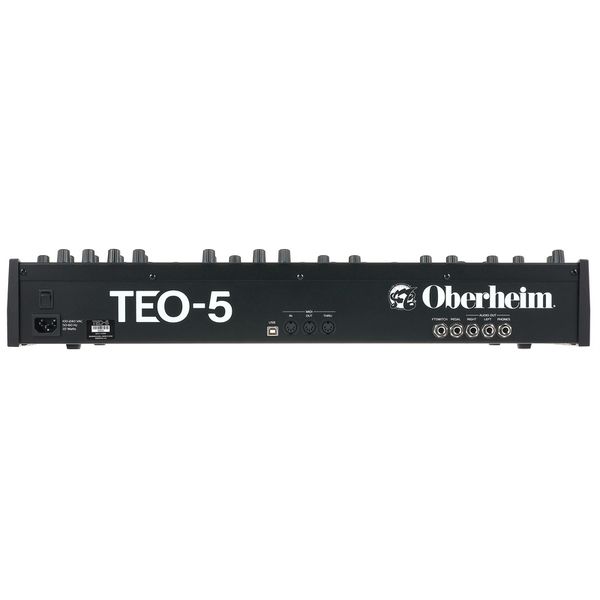
  • Line outputs: 2 x 6,3 mm jack
  • Stereo headphone output: 6.3 mm jack
  • Foot switch input: 6.3 mm jack
  • Sustain pedal input: 6.3 mm jack
  • MIDI In/Out/Thru
  • USB
  • Dimensions (W x D x H): 635 x 324 x 112 mm
  • Weight: 7.7 kg
  • Available since September 2024
  • Item number 589778
  • Sales Unit 1 piece(s)
  • Number Of Keys 44
  • Touch-Sensitive Yes
  • Aftertouch Yes
  • Split Zones No
  • Modulation Wheel Yes
  • Number of simultaneous Voices 5
  • Sound Engine Analogue
  • MIDI interface 1x In, 1x Out, 1x Thru
  • Storage Medium Internal
  • USB-port Yes
  • Effects Yes
  • Arpeggiator Yes
  • Number of Analog Outputs 2
  • Digital Output No
  • Display Yes
  • Pedal Connections 1x Pedal, 1x Footswitch
  • Dimensions 635 x 112 x 324 mm
  • Weight 7,7 kg
1,444
All prices incl. VAT
In stock
1

Golden age in a modern cage

The Oberheim TEO-5 five-voice polysynth combines the abilities of the legendary Oberheim OB-X, the Oberheim Four Voice, and the Oberheim TVS – all in one hardware device. Its genuine analogue sound generation allows it to authentically revive sounds from the past: Equipped as it is with VCOs, VCFs, and envelope emulations, as well as digital chorus, delay, and reverb effects, the Oberheim TEO-5 can create an astonishing variety of sounds. It also offers FM synthesis, a 64-step sequencer for complex melodic structures, and an integrated arpeggiator to create pulsating rhythms. The TEO-5 is played via an Aftertouch-equipped, transposable Fatar keyboard. With all these features, the Oberheim TEO-5 not only offers an instantly recognisable, organic, raw sound – it's also capable of creating entirely new, experimental sounds for unique compositions.

Everything from leads to textures

The Oberheim TEO-5 has two synchronised VCOs. Each voice has a sub-oscillator for truly thunderous bass notes, and the oscillators can also be individually switched to key tracking mode. In addition to the triangle, sawtooth, and variable pulse waveforms, the oscillators can also generate through-zero FM synthesis, which can be used to create particularly interesting textures. White noise can also be switched on in the pre-filter mixer, and the state control of the vintage SEM filter adjusted to employ low-pass, notch, and high-pass settings, with a band-pass mode also available. It is also possible to use the digital effects to add nuance to or fundamentally alter sounds via reverb, delay, and chorus, in addition to which metallic resonances can be created with the ring modulator, while the phase shifter provides more turbulent textures.

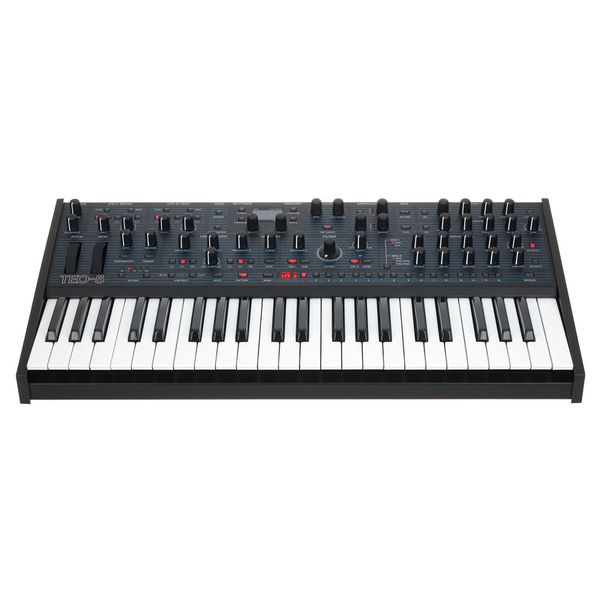
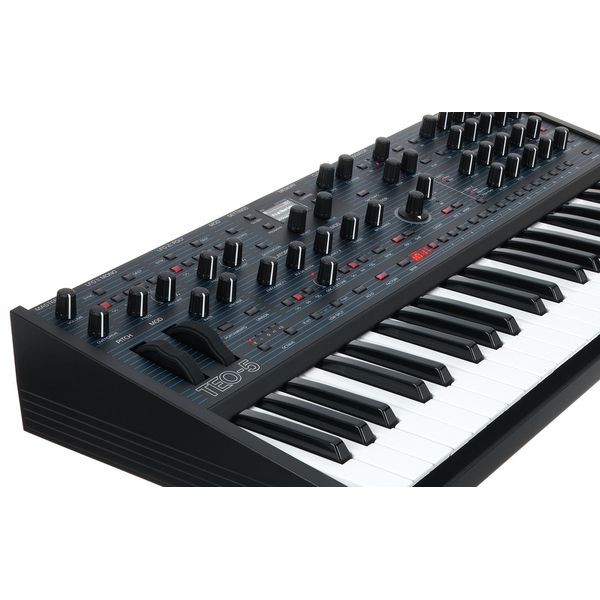
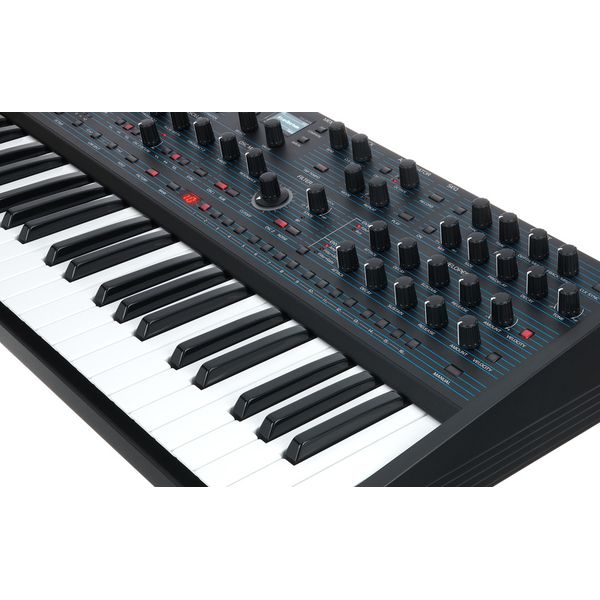
Controller of the Oberheim TEO-5 Synthesizer

For hitmakers and sonic improvisors

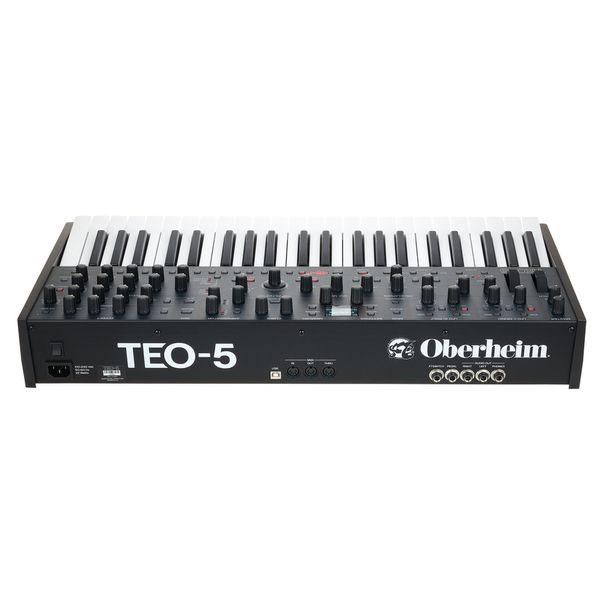
The Oberheim TEO-5 wasn't just designed to generate a wide variety of sounds from the golden age of synthesizers, but also to allow adventurous musicians to experiment with FM synthesis for more modern-sounding productions. The monophonic unison mode allows the user to produce a configurable blend of up to five voices: The priority of the voice triggering can be set at the touch of a button. True Bypass can be used to switch off the digital effects entirely, creating a completely analogue signal path that produces organic sounds straight from the 80s, while the rear panel of the Oberheim TEO-5 offers flexible inputs and outputs for effortless integration into any setup. Digital data can be received and sent to external hardware via the MIDI connections. As well as an optional footswitch, an additional pedal for sustain can also be connected, and silent practice at any time of day (or night) is possible via the headphone connection.

Connections, Oberheim TEO-5 Analog Synthesizer

About Oberheim

The Oberheim company gets its name from innovative American engineer Tom Oberheim, who presented his first analogue synthesizer – the SEM, or Synthesizer Expander Module – at the Audio Engineering Society Convention in Los Angeles in May of 1974. This was followed just one year later by the world's first commercially available polyphonic synthesizer: The Oberheim 4-Voice. These polyphonic synths, created by combining multiple independent synthesizers based on the SEM, made it possible for the first time to play chords and generate multi-timbre sounds at the same time, and an eight-voice model was available by 1976. The compact OB series was launched in 1979, and these models found their way into the hands of Van Halen, Rush, and Queen during the 1980s. In 2016, Oberheim teamed up with Dave Smith Instruments to create the voltage-controlled and polyphonic OB-6. Today, Oberheim is distributed by the Focusrite Group.

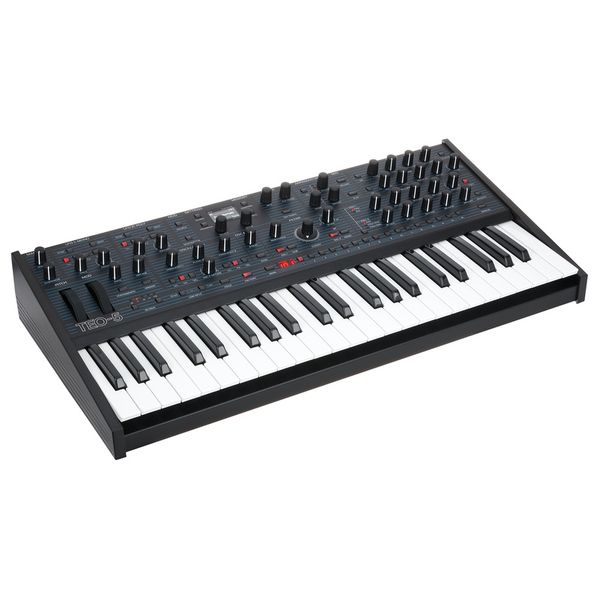
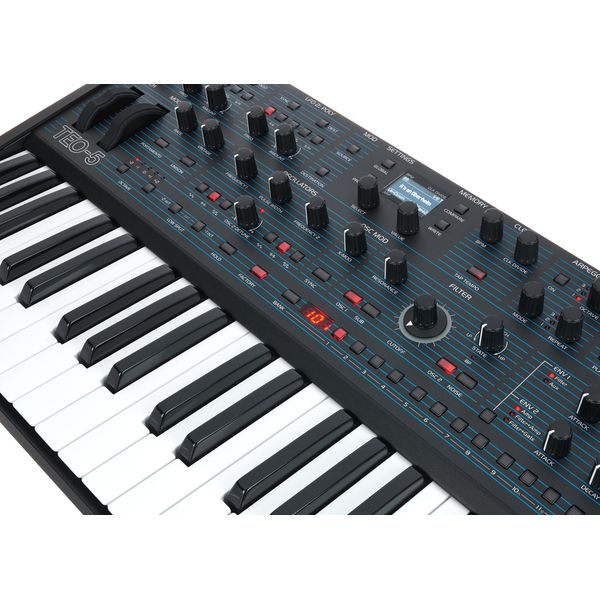
Control panel of the Oberheim TEO-5

Modulate everything

The Oberheim TEO-5 equips its users with extensive modulation options for creating multi-layered sounds. The two LFOs can be routed to freely assignable destinations, offering five waveforms: Triangle, sawtooth, inverted sawtooth, square, and sample/hold (random). In addition, users can synchronise the LFOs to the tempo, allowing them to be perfectly matched to each individual composition. The tempo can be set using the clock function, either manually with an encoder or via tap tempo (there is also a clock divider). Modulation of the velocity values of the five-stage envelope is possible, and for a truly vintage sound, Oberheim's proprietary Vintage mode can additionally be used to add authentically old-fashioned inflections to the behaviour of each voice.

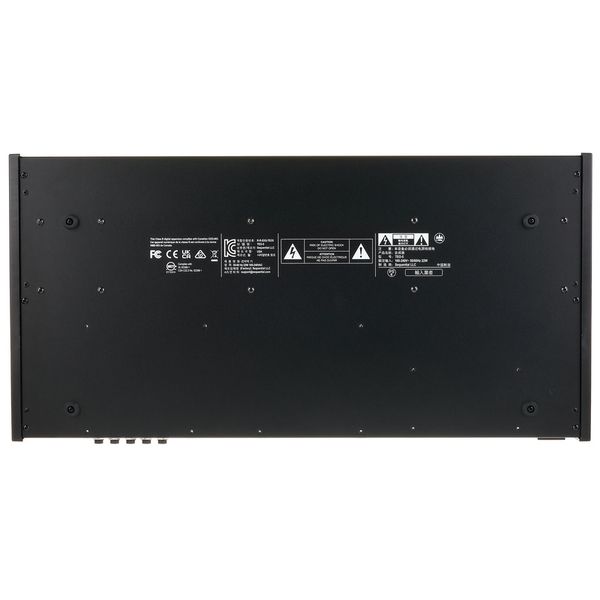
Oberheim TEO-5, rear view

23 Customer ratings

4.8 / 5

handling

features

sound

quality

21 Reviews

R
Is 5 voices enough?
Robert7183 11.06.2025
Very good quality build. Good sound, features etc if you want a cut price Oberheim and therefore great value. I cant complain about any of the shortcomings - small keyboard, only 5 voices, lack of a proper mixer section on the panel, no VCA as I had done my research and accepted them. However, this is probably the first polysynth I have purchased that I really would have liked more voices to get the best out of it. Again, I knew this could be an issue but Im nothing like a good enoigh keyboard player to have needed more voices on similarly limted synths. Maybe I try more complex things because it soinds so good. If you are a decent player who can use more than 5 fingers at a time, you may need to think again to avoid disappointment of lost/stolen notes. In my case its gppd enough for most things I play.
handling
features
sound
quality
1
0
Report

Report

O
Pure Inspiration in Sound and Playability
Orens 21.08.2025
The TEO-5 is one of the most inspiring synths I’ve ever played. The keybed feels premium and super comfortable, the highs are absolutely stunning, and the filter feels like a dream to use. The built-in effects are on a whole other level, adding real depth and character. Sound-wise, it delivers that classic Oberheim warmth and richness, with a modern and compact design that makes creating and performing pure fun.
handling
features
sound
quality
1
0
Report

Report

google translate de
Unfortunately there was an error. Please try again later.
S
Wer den Oberheim-Sound mag, ist hier richtig aufgehoben
Soundscapist 27.09.2024
Ich kann leider keine Vergleiche ziehen zu OBX8 und OB-6. Deshalb bewerte ich nur das Gerät selber. Auch einen Vergleich zum Behringer UB-XA ziehe ich nicht, obwohl ich diesen Synth auch besitze.

- Die Verarbeitung des Geräts ist makellos. Ich habe nichts an der Qualität auszusetzen.
- Die Fatar-Tastatur ist sehr gut spielbar, es gibt aber nur monophonen Aftertouch, was auch vom Preis her ok ist.
- Das Gerät wurde in China hergestellt, deshalb der für Oberheim-Synths günstige Preis.
- Die Klangqualität ist umwerfend, wie man sie aber von Oberheim gewöhnt ist.
- Die Presetpatches sind insgesamt von gehobener Qualität, bei einigen muss ich mich beherrschen, um nicht niederzuknien.
- der große Pluspunkt ist Through-Zero-FM zwischen den beiden Oszillatoren, dadurch lassen sich z. B. e-pianoähnliche Klänge erzielen, siehe Patch 112 "ReedBetween", klingt wie ein Wurlitzer.
- Die Hüllkurven sind ausreichend schnell auch für sehr perkussive Klänge.
- Die Onboardeffekte sind gut, aber nicht hervorragend. Der Reverbeffekt könnte noch etwas Pflege vertragen, hoffentlich durch ein Firmwareupdate.
- Die Bedienung ist insgesamt gut bis sehr gut, aber etwas Menudiving ist erforderlich.
- Ein Editor für MAC/PC ist nicht im Preis inbegriffen, muss also separat erworben werden.
- Firmwarebugs habe ich bisher keine feststellen können, aber ich besitze den Synth auch erst seit ein paar Tagen.

Fazit: Insgesamt bin ich sehr zufrieden, der einzige Wermutstropfen ist die geringe Stimmenanzahl, aber sonst hieße der Synth ja TEO-8 oder gar TEO-10 und würde bei den größeren Brüdern wildern. Ich habe bei Bedienung und Features jeweils fünf Punkte vergeben, wenn die Skala bis 10 ginge, würde ich jeweils eine Neun vergeben.
handling
features
sound
quality
25
3
Report

Report

google translate de
Unfortunately there was an error. Please try again later.
G
Alle hohen Erwartungen 100%ig erfüllt!
Georg8189 29.11.2025
Ich hatte schon viele Synthesizer. Gekauft, gespielt, wirklich ausgereizt und auch wieder verkauft (NordLead, NordWave, Moog, Waldorf, Roland uvm.). Ein Nerd eben ich bin.
Aber dieser TEO-5 hat es mir angetan wie noch keiner zuvor.
Erstens der überragende Klang! Da gibt’s nichts zu bemängeln! Absolut amtlich, und so viele auf Anhieb brauchbare Presets!

Aber vor allem die Bedienung ist eine wahre Freude! Der TEO ist ein echter Freund, der einem mit großen Schritten entgegenkommt. Er ist, wenn man bereits Grundkenntnisse von Synths hat, super intuitiv.
Der Sequenzer! Ein beliebiges Muster über Rec eingespielt und Play gedrückt - schon läuft es wie es soll. Am Moog Sub37 war es ähnlich: Record drücken, einspielen, Play drücken. Nur das der Oberheim hier auch Akkorde annimmt. Mit Clock divide bzw. Tempo in bpm lässt sich das Ganze auch nachträglich noch verändern. Im Unison Modus spielt er dann die Melodie auch auf Tastedruck entsprechend transponiert. Pausen und Ties - kein Problem, hier wurde an alles gedacht ohne es unnötig zu verkomplizieren. Im Display sieht man immer bei welchem Step man ist.
Am schrecklichsten in dieser Hinsicht waren meine Moog Mothers.

Ein weiteres Plus: die hervorragende MIDI-Einbindung. Es gelang auf Anhieb meinen Polyend Step mit dem TEO zu verbinden und zu synchronisieren (mit oder ohne Start/Stop). So einfach wie mit dem TEO war es noch mit keinem Gerät (aber Achtung: der Polyend Step braucht andere MIDI Kabel als die meisten Geräte mit Miniklinke-MIDI), hier bitte machen Sie sich im Netz schlau.
Die hochwertige Tastatur mit Aftertouch (endlich eine die durch die perfekte Kalibrierung des Aftertouch wirklich brauchbar ist!) ist ein Genuss für die Fingerchen.
Drei Oktaven reichen auch für Solos. Insbesondere wegen der Möglichkeit die linke bzw. Bass Seite, quasi gesplittet, um bis zu zwei Oktaven tiefer zu setzen.
Modulationsquellen und Ziele zu definieren geht ebenso einfach und flott.
Also ein rundum wirklich gelungener Synthesizer!
Die Potis machen einen sehr stabilen Eindruck mit sehr angenehmen Drehwiderstand. Ich denke der wird noch in Jahrzehnten funktionieren.
Das er eine MIDI Thru Buchse hat ist ebenso erfreulich, denn beispielsweise bei Clavia Nord (Wave2 und NordLead A1) hatte ich das nicht, was dann Probleme macht, wenn man ein MIDI Clock Signal weiterleiten will. Das geht bei Nord einfach nicht, was sehr frustrierend war. Der TEO kann es.

Das einzige was ich auszusetzen habe ist, dass keine gedruckte Bedienungsanleitung beiliegt. Nur ein kleiner QuickStart Guide.
Das pdf Handbuch zum Download hat 178 Seiten. Am Computer hin und her scrollen nervt. Also muss man es ausdrucken, was mühsam sein kann wenn man keinen guten Drucker hat (gibt es die überhaupt??? sarc/off) . Also ab ins Copy Shop: satte € 51.- für den A4 Druck mit Spiralbindung. Na gut man gönnt sich ja sonst nichts ;-)
Kurzzusammenfassung:
DER OBERHEIM TEO-5 IS THE BEST SYNTH I EVER HAD!

handling
features
sound
quality
1
0
Report

Report