

To the page content

Stereo Shotgun Recorder

  • Stereo M/S microphone (polar pattern: supercardioid) with 2 selectable recording angles (90° / 120°) and mono mode
  • No levelling required due to 32 bit float converter technology
  • 32 Bit / 48 kHz (WAV)
  • Recording media: microSDHC cards up to 32 GB, microSDXC cards up to 1 TB (memory card not included)
  • Line output for direct connection to camera: 3.5 mm stereo jack
  • Headphone output: 3.5 mm stereo jack
  • Recording and streaming via USB to Mac, PC, iOS and Android
  • Power supply via 2x AA batteries (not included) or USB bus power
  • Dimensions (L x W x H): 200 x 70 x 41 mm
  • Weight: 91 g
  • Includes Quick Start Guide, windscreen, 3.5 mm stereo jack cable and shock mount with flash shoe adapter
  • Available since January 2023
  • Item number 557323
  • Sales Unit 1 piece(s)
  • Integrated Stereo Microhone Yes
  • Recording Tracks 2
  • Microphone Inputs 0
  • 48 V Phantom power No
  • Line Inputs 0
  • Storage Medium SD
  • Headphone connection Yes
  • Integrated Speaker No
  • Resolution max. 32 bit
  • Max. Sample Rate 48 kHz
  • Limiter No
  • Polar Pattern Supercardioid
  • Accessories Battery, Mount, Windshield
  • Max. Memory 1
  • Recording Format WAV
  • Power Feed Batterie and USB
  • Dimensions 200 x 70 x 41 mm
  • Weight 91 g
  • Included In Delivery Quick Start Guide, Windscreen, 3.5 mm Jack Cable, Elastic Mount with hot shoe adaptor
179 €
All prices incl. VAT
In stock
1

Stereo audio for any video

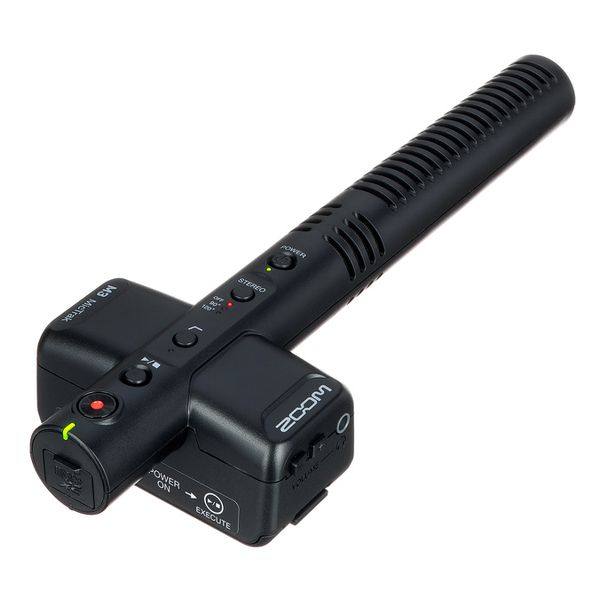
The Zoom M3 MicTrak is a compact stereo recorder and microphone designed specifically for video applications. At its core is an M/S capsule arrangement – a supercardioid mid element focused on sound directly in front of the camera, combined with a bidirectional side element – that captures stereo audio at 48kHz/32-bit float to microSD card or directly via USB-C. The 32-bit float recording engine removes the need to set input levels in advance, and can handle up to 133dB SPL without clipping. Four tracks are recorded simultaneously: decoded stereo plus the raw M/S file, which can be freely adjusted for stereo width in post using the companion Edit & Play software. At 135g including batteries, it is the lightest recorder in the MicTrak range.

Zoom M3 MicTrak Shotgun Recorder

Adjustable stereo width

With 32-bit float, the M3 MicTrak can capture recordings with a wide dynamic range, with distortion is effectively eliminated: Levels can be adjusted flexibly after recording, eliminating the need for manual gain setting in advance. Similarly, the M3 MicTrak's stereo width is switchable between mono, 90°, and 120° – mono for focused dialogue, 90° for accurate transparent stereo capture, and 120° for wider ambient recording. A lo-cut filter reduces low-frequency interference such as handling noise and wind rumble. The interface is deliberately minimal: The record button is front and centre, transport controls handle playback and stop, and the stereo width switch and lo-cut filter are the only adjustments needed during recording. Two AA batteries provide approximately 12 hours of continuous operation on alkaline cells, or up to 21 hours on lithium.

Zoom M3 MicTrak, battery compartment

Optimised for cameras

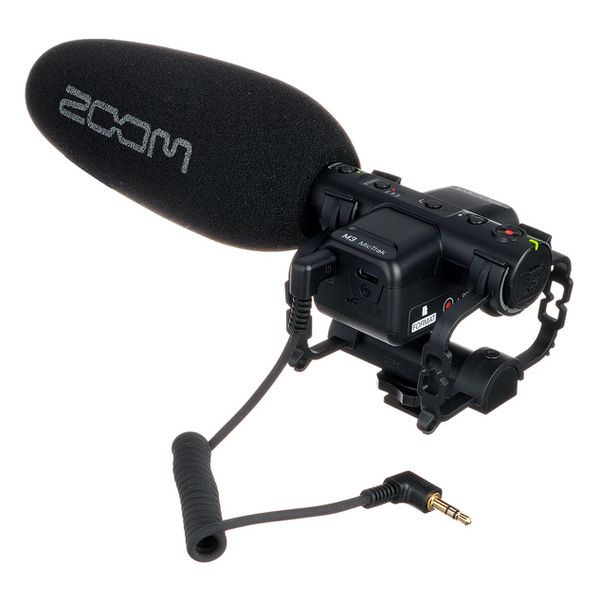
The Zoom M3 MicTrak is designed specifically for use with cameras. Using the supplied hot shoe mount with elastic suspension, it can be attached quickly while helping to reduce unwanted vibrations from the camera body. The audio signal can be fed directly to the camera via the line output, so sound and picture are recorded in sync. In mono mode (stereo off), the M3 behaves like a classic shotgun microphone, focusing entirely on sound coming from in front of the camera. For interviews involving more than one person, for instance, the stereo width can be set to 90°, allowing for a touch of ambient sound while still keeping speech clearly defined. The 120° setting introduces a wider sense of space, capturing more of the surrounding environment. The M3 MicTrak also comes with a foam windscreen, an indispensible accessory for making clean recordings outdoors.

Zoom M3 MicTrak Stereo Shotgun Mic with Recording Function

About Zoom

Founded in 1983, the Japanese company Zoom manufactures a variety of audio equipment, including a range of portable "handy" recorders as well as multi-effects processors, effects pedals, drum machines, and samplers. Over the past thirty years, the company has built a reputation for producing innovative yet affordable products based on original microchip designs. Since the Zoom-9002 (an ultra-compact multi-effects processor that can be attached to a guitar strap) was introduced in 1990, Zoom has become one of the leaders in digital audio processing.

Flexible workflow in post

Recordings made with the Zoom M3 MicTrak are stored to microSD card (up to 1TB SDXC) in 32-bit float WAV format, with BWF metadata support for broadcast and video workflows. The raw M/S file travels with every recording, giving users complete control over stereo width in post without committing to a decoded stereo image at the time of recording – useful when the ideal width isn't clear until the edit. The Edit & Play companion software handles M/S decoding, stereo width adjustment, and normalisation. Recordings can also be converted onboard to 24-bit or 16-bit formats for broader DAW compatibility, and the USB-C port allows the M3 to function as a 2-in/2-out USB microphone at 48kHz/24-bit for direct computer or mobile device recording.

12 Customer ratings

4.2 / 5

features

sound

quality

11 Reviews

A
Versatile recorder
Audiogram78 02.01.2024
I'll be brief. I make short audio documentaries and I also do field recording.
Mostly I will use this for audio documentary work.

Build quality: This is the weak point. The device itself is thin plastic. the battery compartment door and the micro-sd compartment door are very thin plastic.

With careful use you can avoid handling noise. A youtube reviewer has recommended getting a seperate shockmount which gives better access to the battery compartment- I may do this.

Where this device excels is versatility. In my case I often don't use my main M/S microphone as I'm afraid of damage or theft. This device gives the same functionality with slightly lower sound quality and I will have no fear using it.

It weighs virtually nothing, the included foam windshield is fine for indoor use- where I do much of my audio doc work. I have a generic version of a softie for more demanding wind conditions. I haven't tried it, but it looks like the device might fit in a wind blimp, if needed.

The sound quality is very good, perfectly usable, the 32bit audio is great. The editing app is limited but versatile, you can adjust the stereo field width after recording (a raw 32bit file is also recorded at time of recording).

Thomann helpfully include AA batteries to get you started.

The one omission from Zoom (imho) is a USB-C cable, I know they're cheap and ubiquitous but it would be helpful to be able to connect and go straight away as you need to connect the device not only to transfer data but also to adjust various settings (time/date)

All in all, a recommended recorder- I'm not using it on a camera, I'm using it attached to a mini tripod or handle for on-the -go interviews and recording the ambience and details in environments where I make my work.

Recommended
features
sound
quality
0
0
Report

Report

NB
Great bang for the buck!
Not Batman 11.08.2023
We got this mainly as a stereo field recorder but also it could serve occasionally as boom mic and it does both pretty well, especially for the small price.

The design is easy and it's awesome that the SD card slot is on the back, this way when you run this mic on a fully rigged camera, you still have access easily. The RAW WAV format and the Zoom software is interesting, changing to stereo/mono after recording is definitely gonna come in handy here and there.
32bit recording is neat as well, gives a lot of ease of mind when you don't have to worry about clipped audio.
Just remember that it's only internally 32bit, once you plug the mic into your camera you're most likely recording 16bit/24bit, but you can record onto SD card and into the camera simultaneously which is great.

There was a lot of talk about RF interference but this model doesn't have any problems thus far. For the budget I think it's a great choice and I do prefer the mono boom sound quality over the cheaper RODE mics as well. Of course comparing to a 4-figure boom mic ain't fair.
features
sound
quality
2
0
Report

Report

u
Too noisy!
unfa 22.10.2026
Reading all reviews prior to purchase left me believing M3's only real weakness is not-so-sturdy all-plastic construction.
I've read a lot of praise for the sound quality, and maybe that has given me unrealistic expectations.

I am pondering returning the unit or even trying to get a replacement, because the self-noise of the device is quite stunning.

The side mic is especially noisy, but even the mid "shotgun" generates a lot of hiss. I feel like I'm recording to a cassette tape again. Yes, it won't clip if you scream or pop a baloon next to it, that works as advertised and is definitely a killer feature.

Maybe outdoors where there's usually some noise from the environment, the noise floor of this device is not going to be so problematic, but when recording quiet dialogue in a quiet room from 0.5 meters away I feel like I left a radio tuned to static next to my head.

I tested side-by-side with Rode VideoMicro that I was hoping this will be an upgrade to, but at least as far as self-noise goes it's a definite downgrade of ~6 dB.

Of course it's not comparing like-for-like. A more reasonable comparison would be Rode VideoMicNTG, but I don't have one.

Also the shockmount is a joke. It is designed to resemble Zoom's logo, and it would be cool if it worked, but IMO the plastic springs are too short and too stiff to effectively isolate handling noise of the camera.

I have put the M3 on a Rode VideoMic's mount - it was tilting a little bit as the mount was not designed for M3 + batteries + Zoom's deadcat total weight, but when I did a test recording, there was a very clear difference in the amount of low frequency sound transmitted from lightly tapping on the camera body to the mic. With Zoom's shockmount it's TAP TAP TAP, with Rode's it's tap tap tap. Makes me wonder if I could design and 3d-print a better shockmount myself given a couple weeks.

The cable clamps are a nice touch, but they do nothing because the whole shockmount doesn't work. I tested with HyperX Cloud2 headphones (they have a thick cable in a fabric braid). The cable fits snugly in the larger cable clamp holes, but then when I tapped at the cable before the clamps and tapped it with the same force between the M3 unit and the clamps - I heard no difference. All this neat design detail can do is help prevent cables from flapping in the breeze, which maybe could create audible noise - but you'd probably have bigger problems by that point.

Zoom's windscreen is not that great either unfortunately. It's a single-layer deadcat with no foam padding inside.

In comparison Rode VideoMicro's deadcat has foam inside that makes it dual-layer and hence much more effective for not that much more volume.

Zoom's deadcat also comes with a rubber strap, that in my opinion is just dead weight. The port is so stiff I can't tighten it any more suing that clamp, and loosening the string doesn't really make it easier to take the wind shield off.

All in all I think M3 is a neat device and does some incredbile things especially in it's price point but it's no miracle. It's strengths are:

- 32-bit float + raw M/S gives options in post
- low weight
- low profile
- low cost
- configurable stereo image


It's downsides:
- very high self-noise, especially if you want wide stereo - get ready to do a lot of post-processing to clean this up for scenes with quiet dialogue
- placebo shockmount mostly rises the profile so the mic doesn't show up in the camera frame, but doesn't provide any acoustic isolation.
- the chassis is all plastic, it does seem rather thin and I've heard reports of it breaking. I suspect a plastic interference tube is also probably more permeable than a metal one, so it's probably less directional in the mid range for it (should test and measure really)

Best used for:
Cheap on-camera stereo audio for a flycam setup that gives you options in post and backup recording.

Best avoided for:
Quiet indoor dialogue scenes.
features
sound
quality
0
0
Report

Report

google translate de
Unfortunately there was an error. Please try again later.
B
Field recording - next level
Burnald 08.10.2024
Eines vorweg: Ich mache damit hauptsächlich Geräuschaufnahmen, Atmos und ab und zu mal ein Interview.
Das M3 MicTrak liegt gut in der Hand (wenn man es in der Hand hält und nicht auf den Blitzschuh einer Kamera montiert), Griffgeräusche halten sich mit etwas Übung in Grenzen. Es ist auch nicht übermäßig windanfällig und mit dem optional erhältlichen Puschel WSU-2 lässt sich das weiter verbessern.
Das M3 nimmt in 48 kHz und 32Bit float auf und speichert auf eine MicroSD Speicherkarte mit maximal 1TB. Dabei schreibt es parallel zwei Dateien auf die Karte. Eine in RAW (2CH, Seitenmikrofon und Mittenmikrofon) und eine in der am Schalter "Stereeo" eingestellten Stereo-Version, also in XY-typischen 90° Stereobreite oder 120°.
Das Geniale daran ist, dass mit einer kostenlosen Software von Zoom sich im Nachhinein das RAW-File noch beliebig und stufenlos in seiner Stereobreite zwischen 0 und 150° einstellen lässt, um daraus eine weitere alternative Stereoversion zu machen.
Die Aufzeichnung in 32Bit float ist wirklich sehr gut brauchbar, denn dadurch entfällt ein Einpegeln vor Ort komplett. Es muss nur noch aufs Knöpfchen gedrückt werden und die Aufnahme beginnt. Hinterher kann man sich aus der gemachten Aufnahme (auch sequentiell, wenn man es wünscht) den geeignetsten Pegel heraussuchen und entsprechend verstärken.
Dabei klingt es nicht minderwertig, selbst wenn man die Aufnahme nachher um 40 dB hochzieht. 32Bit float ist einfach so praktisch - nie wieder ohne.
Ich habe das M3 mit einem H2n und einem H6 essential mit XY-Kapsel verglichen und finde die Aufnahmen vom M3 etwas besser, besonders Atmos (z.B. Gemurmel Menschenmengen aber auch Stimmen in Interviewsituationen) kommen mit dem M3 etwas klarer getrennt herüber. Ein Vergleich mit dem H6 essential mit SSH-6e steht noch aus.
features
sound
quality
4
0
Report

Report