

To the page content

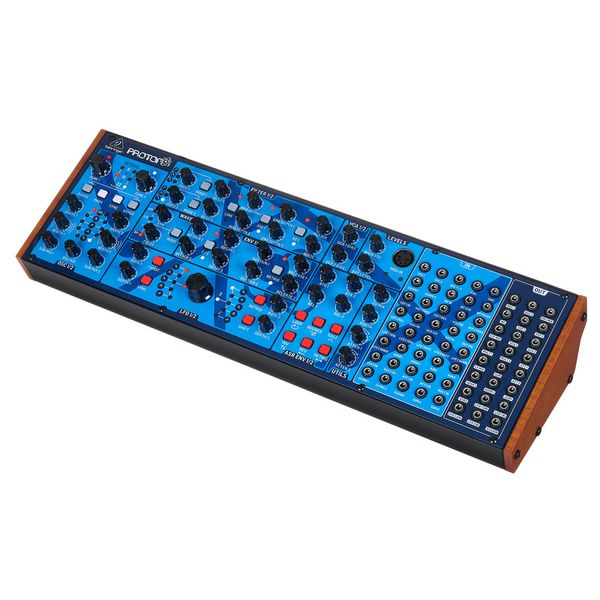
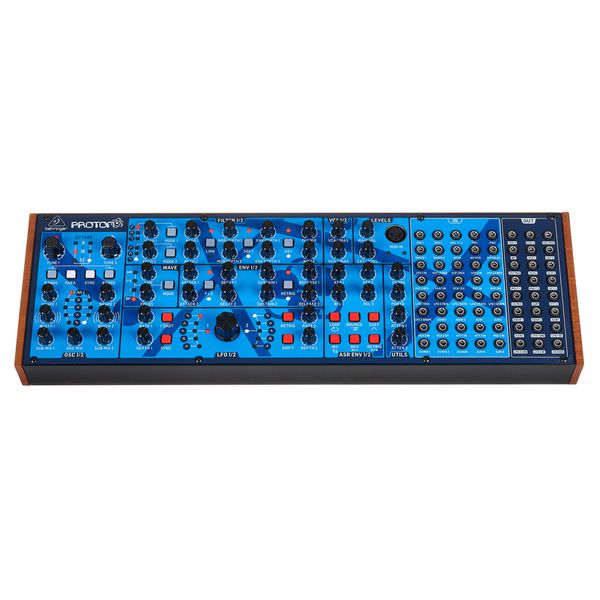
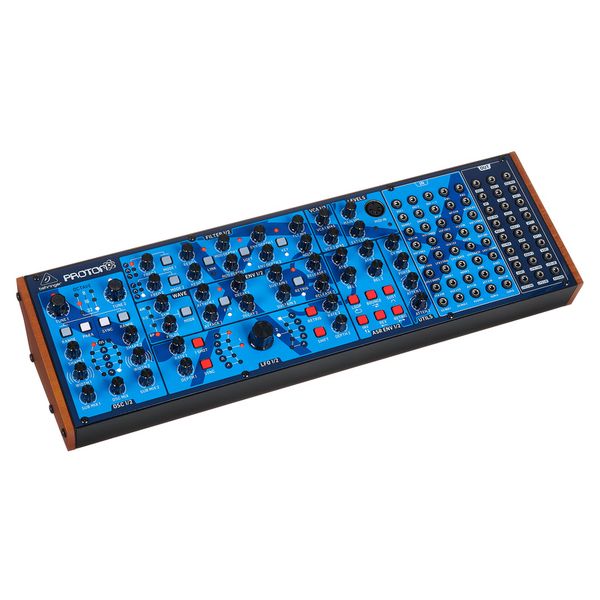
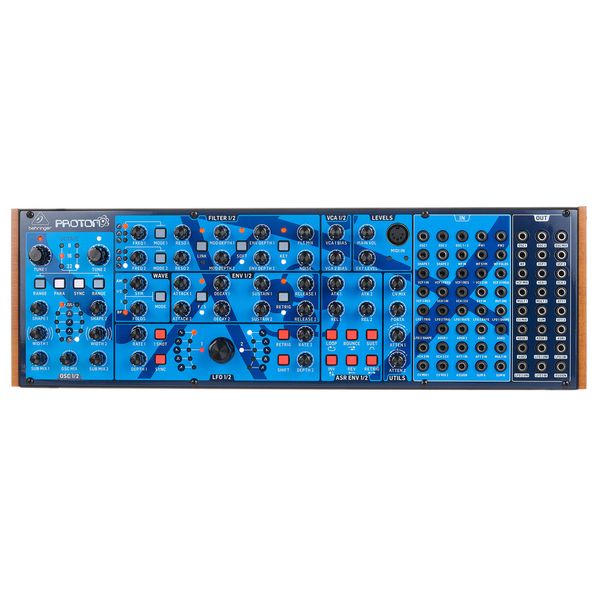
Analogue Semi-Modular Paraphonic Synthesiser

  • 2 VCOs
  • 2 Multi-Mode VCFs
  • 2 VCAs
  • 4 Envelopes
  • Wave Folder
  • Paraphonic mode for independent control of both oscillators for multi-tembral sounds
  • Analogue signal path
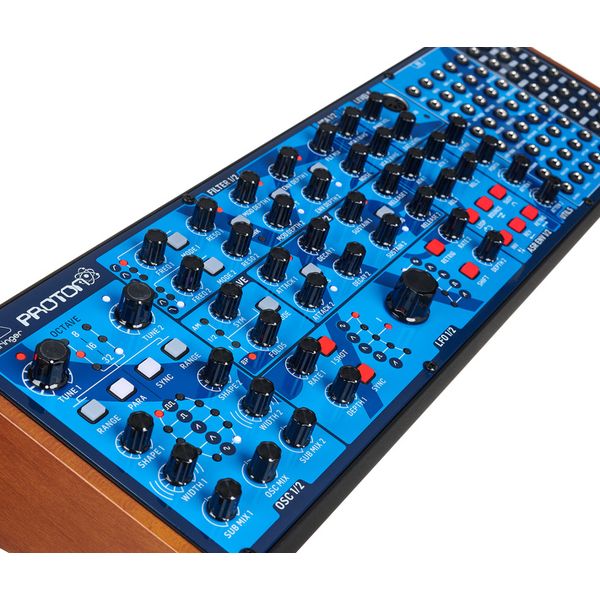
  • Dual oscillators with 5 waveforms, oscillator sync, pulse width modulation and sub-oscillator
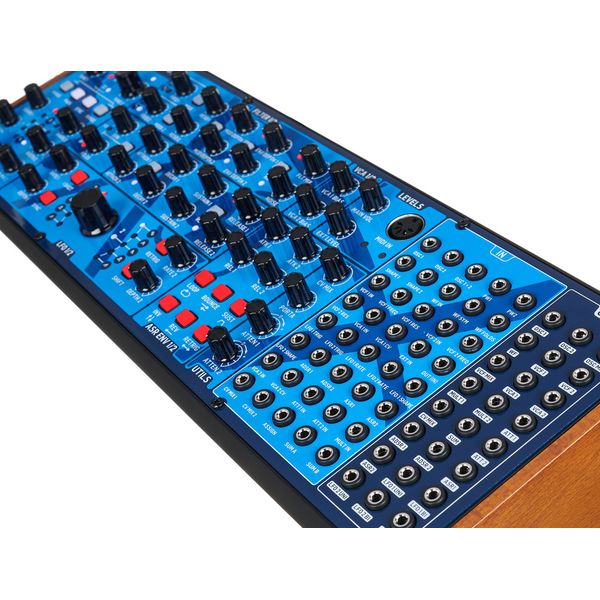
  • Patch panel with 40 inputs and 24 outputs with 3.5 mm mini jacks
  • Can be installed in Eurorack housing (width 80 HP)
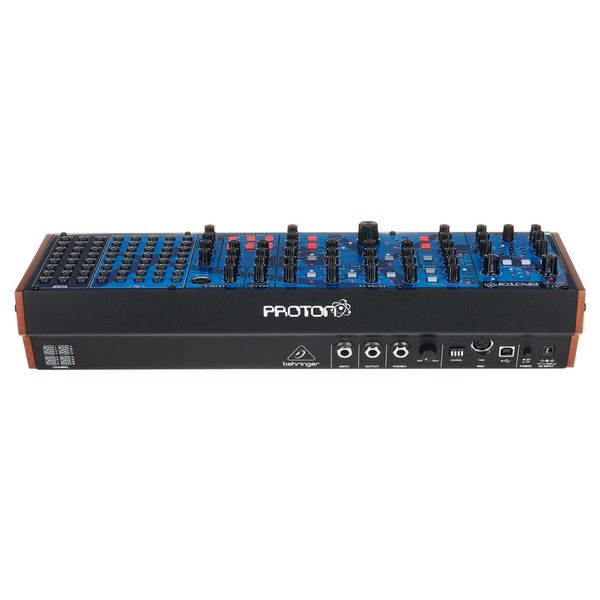
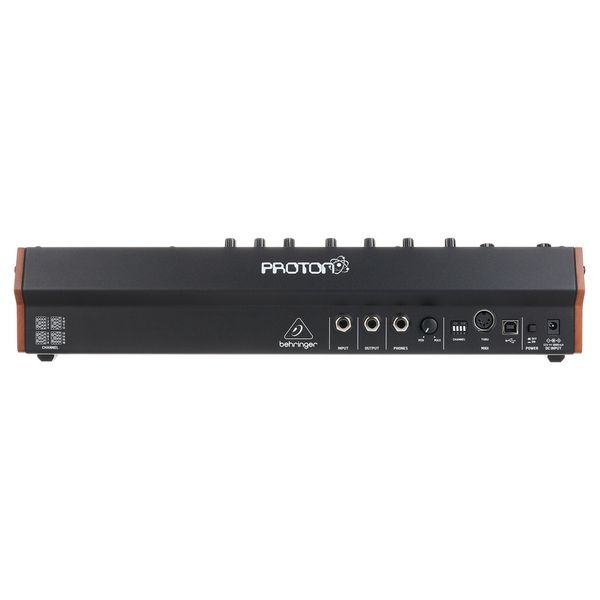
  • Line input: 6.3 mm jack
  • Line output: 6.3 mm jack
  • Stereo headphone output: 6.3 mm jack
  • MIDI In / Thru
  • USB 2.0
  • 64 Patchbay inputs and outputs: 3.5 mm mini jack
  • Dimensions: (W x H x D): 424 x 94 x 136 mm
  • Weight: 2.0 kg
  • Available since August 2024
  • Item number 596518
  • Sales Unit 1 piece(s)
  • Design Desktop
  • Polyphony 1
  • Sound Generation Analog, Synthesis
  • MIDI interface 1x In, 1x Thru
  • Storage Medium None
  • USB-port Yes
  • Effects Yes
  • Arpeggiator No
  • Number of Analog Outputs 1
  • Digital Output No
  • Display No
  • Optional Expansions 0
  • Special Features semi modular, Eurorack compatible
324 €
All prices incl. VAT
In stock
1

35

4.5 / 5

handling

features

sound

quality

28 Reviews

D
Two Issues but Great Synth
DeeYellGee 01.09.2024
So the two issues first:
* My synth did not come with a US power adapter. I have lots so I plugged it in with the one from my old Neutron...
* It did not power up, so I opened it up and saw that the ribbon cable from the daughter board was completely disconnected from the main board. Simple fix and it started up.

So I am not sure whose fault that is but I was glad I could avoid returning it.
Once it was running, my experience was all positive.

The dual filters is a dream come true, especially paired with dual LFO's and dual looping ASRs. I love the multishape LFO/OSC with morphing control. I don't know why the default is to step them, but once that was set up properly, I am getting so many great complex musical sounds. It even has dual VCA's which offers some interesting ideas for a stereo path (VCA2 is normalled to the output of the VCF2 with VCA1 handling a mix. Simply using them as a stereo pair, you can have two different filters in parallel.

Missing are the excellent bucket brigade delay, sample and hold, and overddrive, but the additions allow for a richer set of sounds than the Neutron, (and I still have those features in my OG neutron... along with a stupid amount of eurorack modules).

I consider an instrument worthwhile if playing it helps creativity and performance. My experience in a few days of use is two new songs based on patches I came up while exploring.

tldr; The synth is great. The quality of the unit including power supply and detached daughter board was disappointing and could create real struggle for a novice.
handling
features
sound
quality
15
3
Report

Report

B
Try feedback!
Bromann 08.10.2025
Great and versatile semi modular synth! Make sure you try feedback routing to get the most out of it. Send the output into EXT IN, crank up EXT Level, and mess around with the wavefolder. Send it through one of the attenuverters to experiment with negative feedback instead.
handling
features
sound
quality
2
0
Report

Report

E
If one mono synth then this one
Evgeny1123 18.12.2025
The best mono module I could find.

I can see why it's more expensive than polyphonic pro-800 - all the patch sockets, buttons and leds cost money. The lights look fantastic in darker room.

UPDATE after 1 year:

It's a real deal. The company should stop doing countless clones and do more innovation like this. All the mono clones are more or less the same: 2 VCOs, 1 VCF, 1 VCA, 1-2 LFO, ADSR for filter, ADSR for amplifier. Proton has all that and more.

Proton can be a base for modular setup, its internal modules are fully accessible, and there are more modules than in any of the Behringer clones. It's possible to learn modular technology using Proton only, and it is the cheapest way.

The 2 VCF can be 3 different filters: one single filter is 12 db/octave, two in parallel is 6 db/octave, 2 in series is 18 db/octave.

I wish Behringer made a similar system with modular utils to combine with Proton, with things like mixers, buffered multiplies, proper MIDI to CV, S&H, effects, etc.

But for now it's possible to combine Proton with a Tiptop Audio Happy Ending Kit rack, and add any needed additional modules there.

Notes:
1) The MIDI input would be better if CV/Gate output was exposed on the patch panel. Then it would be possible to drive external modules. But it's wired internally to VCOs, VCFs and ADSRs. For an expansion with external modules, a separate MIDI to CV module is needed.

2) Each oscillator has a "sub-oscillator" one octave lower, and it can not be turned off completely, even in software. It seems to be possible via MIDI codes, but I didn't manage to figure it out. The sub-oscillators don't affect sound much on the lowest settings, but they do make graphs on an oscilloscope confusing.

3) Behringer packed too many features into a small box which make it a bit unintuitive. Reading manual is necessary: the routing and modulation logic is not obvious from front panel, and there are essential hidden key combinations. There is also good guidance on youtube.

4) The hardware quality is good, it holds, the knobs are solid. However the marks on the knobs are made with paint, and on some knobs it's hard to see them. I will need to figure out something to make the marks more visible.
handling
features
sound
quality
0
0
Report

Report

C
Deep, flexible and powerful, even if not my main workhorse
Charlesalbert 12.02.2026
The Proton is a very well thought-out instrument. The patch bay is excellent, the modulation possibilities are extensive, and the waveshaping options give it a wide tonal palette that can move from classic analog warmth to more modern and aggressive textures.

Having two oscillators with their own filter paths is a strong design choice. It allows for complex layering, interesting stereo movement, and detailed timbral sculpting that you do not always find in compact semi-modular synths. The routing encourages experimentation, and it is easy to go from structured sounds to more exploratory patches.

I also appreciate that this is an original Behringer design. It does not try to be a clone but instead offers its own identity, which is refreshing in a market full of recreations.

That said, speaking personally, this is probably the unit I use the least among my setup. Part of that might be because I already own instruments like the Neutron that cover some similar ground, and I simply have not spent enough time pushing the Proton as deeply as it deserves.

But every time I power it on, I recognize that it is a serious synthesizer. The sound is solid, modulation is rich, and there is a lot of potential waiting to be explored. With more dedicated time, I am sure it could easily become a centerpiece for many producers.

In short: maybe not my most used machine, but undeniably a very good one.
handling
features
sound
quality
0
0
Report

Report