

1

4.3 out of 5 stars from 3 customer ratings
€769
-10%30-days best price: €859

4.3 out of 5 stars from 3 customer ratings

4.4 out of 5 stars from 228 customer ratings

4.6 out of 5 stars from 133 customer ratings

4.6 out of 5 stars from 1268 customer ratings

4.8 out of 5 stars from 5 customer ratings

4.7 out of 5 stars from 114 customer ratings

5 out of 5 stars from 8 customer ratings

4.8 out of 5 stars from 10 customer ratings

4.7 out of 5 stars from 30 customer ratings
4.6 out of 5 stars from 133 customer ratings
4.7 out of 5 stars from 30 customer ratings
4.7 out of 5 stars from 114 customer ratings

4.7 out of 5 stars from 101 customer ratings
5 out of 5 stars from 8 customer ratings

4.5 out of 5 stars from 79 customer ratings

4.4 out of 5 stars from 883 customer ratings

3.9 out of 5 stars from 44 customer ratings

4.7 out of 5 stars from 4 customer ratings

5 out of 5 stars from 10 customer ratings

4 out of 5 stars from 1 customer ratings

4.7 out of 5 stars from 46 customer ratings

4.9 out of 5 stars from 11 customer ratings

4.7 out of 5 stars from 4 customer ratings

4.5 out of 5 stars from 922 customer ratings

4.6 out of 5 stars from 15 customer ratings

4.7 out of 5 stars from 7 customer ratings

4.6 out of 5 stars from 9 customer ratings

4.6 out of 5 stars from 269 customer ratings

4.5 out of 5 stars from 30 customer ratings

5 out of 5 stars from 1 customer ratings

5 out of 5 stars from 3 customer ratings

4.8 out of 5 stars from 12 customer ratings

4.8 out of 5 stars from 5 customer ratings

5 out of 5 stars from 1 customer ratings
4.3 out of 5 stars from 3 customer ratings

5 out of 5 stars from 1 customer ratings


5 out of 5 stars from 1 customer ratings

4 out of 5 stars from 1 customer ratings


5 out of 5 stars from 1 customer ratings


4.5 out of 5 stars from 2 customer ratings

4.3 out of 5 stars from 3 customer ratings
4.8 out of 5 stars from 10 customer ratings
5 out of 5 stars from 1 customer ratings
4.4 out of 5 stars from 228 customer ratings
4.7 out of 5 stars from 101 customer ratings
4.7 out of 5 stars from 114 customer ratings
4.7 out of 5 stars from 46 customer ratings
4.5 out of 5 stars from 79 customer ratings

4.7 out of 5 stars from 124 customer ratings
4.9 out of 5 stars from 11 customer ratings
4.8 out of 5 stars from 5 customer ratings
5 out of 5 stars from 8 customer ratings

4.7 out of 5 stars from 32 customer ratings
4.4 out of 5 stars from 883 customer ratings
4.6 out of 5 stars from 1268 customer ratings
3.9 out of 5 stars from 44 customer ratings
4.5 out of 5 stars from 922 customer ratings
4.6 out of 5 stars from 133 customer ratings
4.7 out of 5 stars from 30 customer ratings

4.6 out of 5 stars from 269 customer ratings

4.7 out of 5 stars from 4 customer ratings

4.8 out of 5 stars from 8 customer ratings

5 out of 5 stars from 1 customer ratings


4.8 out of 5 stars from 8 customer ratings


4.8 out of 5 stars from 488 customer ratings

4.3 out of 5 stars from 11 customer ratings

4.5 out of 5 stars from 31 customer ratings


4.6 out of 5 stars from 16 customer ratings


A digital piano or electric piano is quite simply the next best thing to a real piano: It's almost impossible to distinguish the sound of a good-quality digital piano from that of a real piano, even a grand piano. The difference is that a digital piano produces sound digitally, output via speakers or headphones. This means that you can practise playing the piano almost silently, but you will also be prepared for a big performance in front of an audience. By the way, digital pianos are often also referred to as electric pianos or electronic pianos. Electric grand pianos or digital grand pianos are also digital pianos, modelled on the design of classic concert grand pianos.
The following buyers' guide is intended to help you find the best digital piano for you, whether you're a beginner planning to play at home or a more advanced player who's ready for the stage. Because we understand that there's always a certain level of trust involved when you buy a musical instrument, Thomann's famous 30-Day Money-Back Guarantee ensures risk-free and relaxed shopping. And after your purchase, our 3-year warranty gives you the peace of mind to enjoy your product for as long as possible.
There are digital pianos for children and beginners available for less than 200 euros; even these inexpensive instruments are capable of very faithfully reproducing the authentic sound of a piano. After the sound itself, the feel of the keys and keyboard is an almost equally important factor when buying a digital piano. With a real upright or grand piano, the keyboard plays a huge role in the feel of the instrument and thus in your playing technique: Beginners in particular should make sure that the keyboard of their electric piano feels as much as possible like a genuine piano. However, we don't just look at sound and playability when choosing a new instrument – looks are important too. Your new digital piano will be an eye-catcher however else you decorate your home, and as such they are available in a wild variety of models, colours, and finishes. If you are looking more for a portable and robust solution for the stage, try one of our stage pianos, lightweight digital pianos in a keyboard-style format.
Our online guide to digital pianos provides detailed information on all the things you might have to think about when buying an electric piano. For personalised advice or help at any time, feel free to visit us, or contact Thomann's keyboard department by e-mail at homekeys@thomann.de or by telephone on +49 (0)9546-9223-33.

The first electric pianos only imitated the sound of a piano electronically, creating a mere approximation of the original. The advent of digital technology brought the breakthrough, allowing an almost entirely faithful reproduction of the sound of a real piano. To achieve this, the sound of real pianos (even grand pianos) is sampled, i.e. recorded, several times, key by key. This preserves not just the note being played, but also the individual playing dynamics, harmonic overtones, and even background noises that can occur when a piano is played. When you press a key on a digital piano, these samples are retrieved, reproducing the recorded sound in all its facets. The more attention a manufacturer devotes to the sampling process, the more lifelike the sound of an electric piano will be – of course, this is invariably reflected in the price. Another method applied to create largely authentic piano sounds is modelling technology: This involves analysing the entire gamut of sounds an upright or grand piano can produce using digital technology, with the results stored as a complete data package. Each time a note is played on a digital piano, the requisite analogue sound can be generated from the underlying digital data.
The construction and quality of any piano's keyboard is fundamental for the instrument's touch and playing feel. Traditional upright and grand pianos have what is called hammer action, where a hammer strikes a string when a key is pressed. Manufacturers of digital pianos try to reproduce this characteristic playing feel in various ways, principally by equipping their high-quality digital pianos with weighted keys: A complex raft of mechanisms mimics the resistance, pressure point, and general feel of each individual key of a hammer action piano. The keys themselves are made of plastic on inexpensive digital pianos, and of wood and synthetic ivory on higher-priced models. Their texture and feel will play an important part in your personal playing experience. A digital piano's touch sensitivity, often called velocity sensitivity, ensures that a note sounds louder or softer depending on the intensity with which you play the keys. The number of keys on a digital piano can vary depending on its size. Standard keyboards have 88 keys, just like an upright or grand piano.
Traditional pianos have three pedals, and this standard setup will also be mirrored on any good electric piano. The soft pedal generates a softer sound, while the sostenuto pedal extends the notes that were being played while the pedal was depressed. Finally, the sustain pedal ensures that all notes ring out for longer. Digital pianos without their own pedals should have connections for external pedals, and even inexpensive electric pianos should at least have the option of connecting a sustain pedal.
Electric pianos use samples of real pianos as the basis for their sound, which is output via built-in speakers or headphones. Many digital pianos have additional sounds sampled from other keyboard instruments such as the spinet or harpsichord, but also the organ or even stringed instruments. Effects such as echo, reverb, Leslie. and more are also included with many instruments.
Polyphony indicates how many notes an electric piano can play simultaneously. A polyphonic piano capable of producing 128 notes (or more) should be standard you aim for; this is because, in addition to the notes currently being played, notes that are still sustaining also have to be taken into account - particularly when using a sustain pedal or when playing complicated pieces involving rapid successions of notes.
If you are planning on connecting your new digital piano to a larger sound system or a mixer, it must be equipped with a line output. Headphone and pedal connections are also a practically universal standard; also widespread is an audio- input for connecting a music device. Electric pianos with USB/MIDI connections can be updated and edited via computer: Many manufacturers offer additional sounds or functions for download, allowing you to broaden your instrument's palette. And if you frequently work with recording software using DAWs, USB/MIDI connectivity means your piano can serve as a master keyboard.
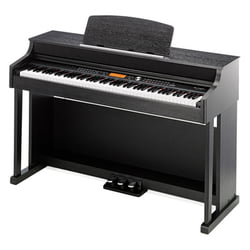
Broadly speaking, we can distinguish between standard digital pianos, digital grand pianos, compact digital pianos, and stage pianos. Among the most noteworthy manufacturers of digital pianos are Yamaha, Thomann, Kawai, Roland, and Korg; their years of experience guarantee the authentic sounds and high-quality keyboards of their digital pianos.
The broadest spectrum when it comes to price and features is the category of standard digital pianos, ranging from a lightweight, portable instrument like the Thomann SP-320 to the ultra-high end Yamaha N-1X Avant Grand. Beginners, especially, are advised to take a look at our bundles, which also include a piano stool, headphones and stand: One quality package is the Thomann DP-28 Digital Piano Bundle.
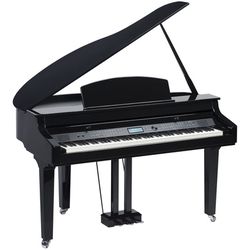
Digital grand pianos are exquisite instruments in their own right, and offer the very highest standards with regard to both sound quality and the workmanship of their keyboards and finish. Here, too, bundles such as the Thomann DP-275 GP WHP Set combine outstanding electric grands with all the necessary accessories.
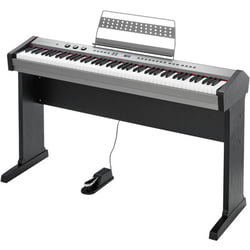
The category of compact digital pianos comprises – logically enough – lightweight, portable instruments. Some of these digital pianos are also suitable for the stage, with a range of functions that often goes far beyond what one would expect of a standard electric piano. One such multifunctional favourite is the Thomann SP-5600, a keyboard/stage piano with a battery of more than 600 sounds.
Last but not least are the stage pianos, which are of course primarily designed to be played live on stage. Brands such as Clavia, Roland, Yamaha, Kawai, and Thomann offer portable instruments with a wide range of functions, providing harmonies and melodies for every style of music. This category ranges from the phenomenally powerful flagship Clavia Nord Stage 4 88 to the many affordable Thomann models, such as the DP 26 and DP 28 Plus or the SP 120 and SP 320, which are also available as a bundle.


